The Experiment Is Over. The Reckoning Is Here.
As of May 12, 2026, Kyndryl's senior vice president for the Microsoft Alliance published a piece that captures the moment precisely: the age of AI experimentation is over. The true test of enterprise AI lies in operationalizing these systems, and for organizations without a clear path from pilot to production, the operational debt is already accumulating and will become overwhelming.
That framing lands against a backdrop of data that makes the urgency concrete. According to Mayfield's 2026 CXO AI Survey of 266 IT and innovation leaders across Fortune 2000 companies, 72% of enterprises are either in production with or actively piloting agentic AI. 42% are already in production. The question has formally shifted from whether to adopt to how to scale.
And yet, only 11 to 14% of enterprise AI agent pilots have reached production at scale, with 86 to 89% failing to realize durable value. The math is stark. Most organizations are running agentic AI somewhere. Almost none of them are running it everywhere it needs to run to produce the returns that justified the investment. The gap between those two positions is not a technology gap. It is an operational debt that grows with every month a pilot sits without a production path.
What Operational Debt Actually Means
The concept of technical debt is familiar to every CIO and engineering leader: the cost of shortcuts taken during development that must eventually be repaid through rework, refactoring, or failure. Operational debt in agentic AI works similarly but compounds faster and surfaces more publicly.
The biggest mistake enterprises make is treating AI agents as isolated pilots rather than embedding them into the enterprise fabric. Organizations build impressive agents in sandbox environments but fail to integrate them with core systems, data flows, and business workflows. Enterprises don't fail because the AI doesn't work; they fail because the supporting ecosystem isn't ready for it.
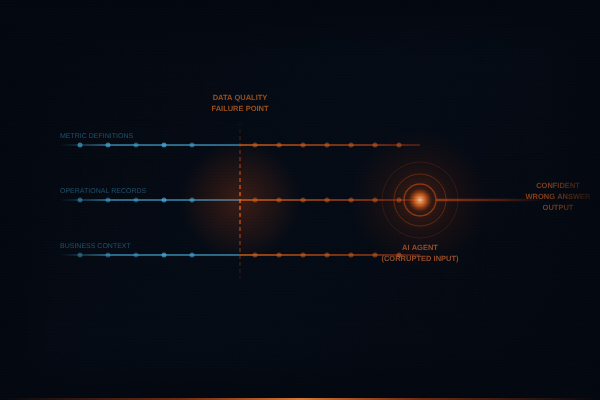
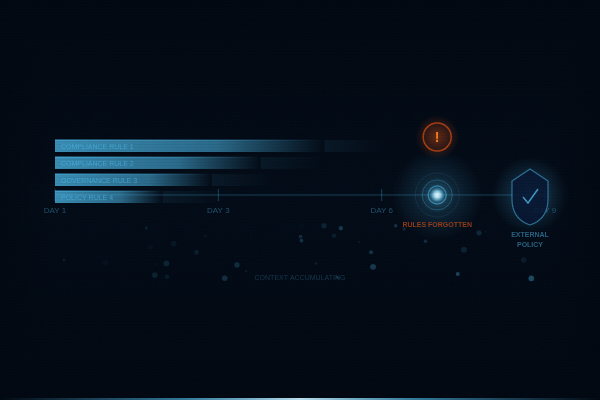
Each pilot that runs without a defined production path accumulates debt in several specific forms. Integration debt accumulates when agents are built in isolation from the enterprise systems they will eventually need to access, meaning that the production deployment requires rebuilding rather than deploying. Governance debt accumulates when agents operate without formal identity, access controls, audit trails, or escalation protocols, meaning that scaling the agent also scales the compliance and security exposure. Data debt accumulates when agents are trained or tested on curated samples that do not reflect production data quality, meaning that the performance gap between pilot and production is discovered after deployment, not before.
The number one blocker is data readiness and quality, cited by 58% of CXOs. This is the fifth consecutive year that integration and data quality have outranked all other concerns. That statistic deserves emphasis. Five years in a row. Organizations have known about this constraint since before agentic AI was the dominant conversation, and the majority have still not resolved it. The operational debt from that deferral is compounding.
The Agent Sprawl Problem
As agentic AI deployments multiply across functions without centralized coordination, a secondary form of operational debt is emerging that researchers are beginning to call agent sprawl. While agentic AI enterprise adoption has reached 72% in production, a massive 60% governance gap remains.
Without a proper orchestration layer, organizations risk agent sprawl, where disconnected AI agents operate in silos without shared context. Individual business units deploy agents for their specific use cases. Each agent has its own data access model, its own output validation approach, and its own implicit governance assumptions. Collectively, they create a fragmented system where no single leader has visibility into what the full portfolio of agents is doing, what data it is accessing, or what risks it is creating.
Only 23% of enterprises have formal agent identity or inventorying strategies, leading to fragmented control and shadow deployments. The operational debt from agent sprawl is not just a technology problem. It is a board-level governance problem. As agentic systems move into mission-critical workflows, the absence of centralized visibility and control creates regulatory, reputational, and operational exposure that accumulates silently until an incident surfaces it.
What the Organizations Reaching Scale Are Doing Differently
The 11 to 14% of organizations that have successfully moved agentic AI from pilot to production at scale share a set of practices that distinguish them from the majority still accumulating debt.
Production is the new baseline. With 42% in production and 30% piloting, the question has shifted from should we adopt to how do we scale. The biggest unlock is the compounding effect: once you remove friction in documentation, data access, and analysis, everything accelerates.
The organizations achieving that compounding effect did not get there by deploying faster. They got there by building the foundational infrastructure that makes each subsequent deployment cheaper, faster, and more reliable than the one before. That infrastructure has three components that appear consistently across the successful deployments documented in 2026 research.
The first is platform-first architecture. Rather than deploying point solutions for each use case, the organizations scaling most effectively are building shared infrastructure: shared compute, shared data pipelines, shared governance frameworks, and shared observability tooling. AI demand is growing faster than compute, data pipelines, or governance can keep up. The only way forward is platformization: shared compute, shared data, shared guardrails. Each new agent deployment draws from this shared infrastructure rather than building its own, which is why the cost and time to deploy drops dramatically after the platform is established.
The second is stage-gated deployment with defined production criteria. The systematic, blueprint-driven approach that distinguishes successful scaling includes stage-gated piloting, where teams frame problems, define baseline success and risk metrics, and conduct scenario-based validation before advancing to production. This is not bureaucracy. It is the quality gate that prevents the integration debt, governance debt, and data debt described above from entering production. Organizations that deploy without defined production criteria are not moving faster. They are deferring costs that will be paid later at higher interest.
The third is human-in-the-loop design as a deliberate architecture choice, not a temporary compromise. 52% of organizations now rely on a human-on-the-loop model, allowing systems to operate with reduced direct oversight while maintaining supervisory control. The organizations producing the strongest results are not the ones that automated the most without human involvement. They are the ones that identified precisely which decisions benefit from human judgment and designed agents that escalate to humans at those points rather than proceeding autonomously. That design choice is what makes agents trustworthy enough to deploy in regulated and mission-critical environments.
The Cost of Getting This Wrong
The cautionary examples from 2026 are instructive. Klarna's move to agentic automation resulted in mass layoffs but quickly reverted when quality and manageability faltered, necessitating hybrid models and rehires. Healthcare agentic pilots suffered security incidents in nearly 93% of cases, underscoring the perils of deploying before tight controls are in place.
Enterprise AI agent development costs in 2026 range from $60,000 for midscale pilots to over $300,000 for regulated, production-grade implementations, with integration and governance often consuming up to 60% of project budgets. Ongoing maintenance and compliance monitoring can add a further 20 to 50% to total cost of ownership.
These are the costs that operational debt produces when it surfaces. Organizations that deploy agents without adequate integration, governance, and data infrastructure do not avoid these costs. They defer them, and they pay them later with higher urgency, less optionality, and more organizational disruption.
The ROI data makes the right approach clear. On average, companies earn $3.50 for every $1 they invest in agentic AI, while the top 5% globally earn about $8 per $1. KPMG estimates agentic AI will lead to $3 trillion in corporate productivity and a 5.4% EBITDA improvement for the average company annually. These returns are not available to organizations whose agentic deployments are stuck in pilot mode or generating inconsistent production results due to inadequate infrastructure. They are available to the organizations that built the foundation required to reach and sustain production at scale.
The Operational Excellence Imperative
The next frontier of AI is not larger models or more autonomous agents. It is boring but essential operational excellence. That framing from Kyndryl's Gonzalo Escajadillo is the most practically useful description of what 2026 requires from enterprise AI leadership.
The organizations that will be best positioned at the end of 2026 are not the ones that deployed the most agents. They are the ones that built the operational infrastructure to run agents reliably, govern them defensibly, and improve them continuously. Managing agentic AI is less about crafting clever prompts and more about ensuring AI systems are reliable, governed, integrated into core workflows, and aligned to business outcomes.
For C-suite leaders, the relevant questions are specific. What percentage of your current AI pilots have a defined production path, with clear integration requirements, governance frameworks, and success metrics? What is the total operational cost of your current AI portfolio, including maintenance, compliance monitoring, and the integration work that did not make it into the original business cases? How many agents are operating inside your organization without centralized inventory, identity management, or audit trails?
The answers to those questions define the size of your operational debt. The organizations that are auditing honestly and addressing that debt before it becomes a crisis are the ones that will reach the $3.50 to $8 return per dollar that the data shows is achievable. The ones that continue deploying pilots without production paths are building a liability that will surface at the worst possible time.
This is precisely the work that KAIDATA exists to do. Auditing the current AI portfolio, identifying the integration, governance, and data gaps that separate pilots from production, and building the foundational infrastructure that makes sustainable scale possible. The experimentation phase is over. The organizations that treat operational excellence as the strategic priority of 2026 are the ones that will own the compounding advantage on the other side of it.