The Acquisition That Should Make Every Enterprise Leader Pause
On March 27, 2026, SAP announced its agreement to acquire Reltio, a cloud-native master data management company that Gartner had named a Leader in its 2026 MDM Magic Quadrant only weeks earlier. The terms were not disclosed, but analysts pegged the deal value above $1.7 billion. The acquisition is expected to close in the second half of 2026.
SAP is the enterprise software company that runs the back office of nearly half of global GDP. Its ERP systems sit at the operational core of over 400,000 companies in 180 countries. When SAP decides to spend more than a billion dollars to solve a problem, the problem is real, it is widespread, and it has been blocking value that SAP's customers have not been able to capture.
The problem SAP just spent over a billion dollars to solve is data readiness. Specifically, the fact that most enterprise data is too fragmented, too inconsistent, and too poorly governed for AI to reason over reliably. SAP's own executive board member for product and engineering, Muhammad Alam, said it directly: the acquisition allows SAP to deliver on the promise of AI that cuts across the full enterprise and to complete the enterprise data platform story.
Reltio does not build AI models. It does not build AI agents. It builds the infrastructure that makes AI models and agents reliable by ensuring they operate on clean, unified, governed data. That is what SAP just decided it needed to own. And the reason it needed to own it is the same reason that most enterprise AI programs are generating activity instead of returns.
What Reltio Actually Does and Why SAP Needed It
To understand why this acquisition matters, it helps to understand the specific problem Reltio solves.
Most enterprises run multiple software systems that each hold different versions of the same information. A customer record might exist in the CRM, the ERP, the billing system, the support platform, and the marketing database, each with slightly different information, slightly different formats, and no single authoritative version. The same product might have different identifiers in procurement, inventory, and finance. The same supplier might appear under different names and addresses across systems that were never designed to talk to each other.
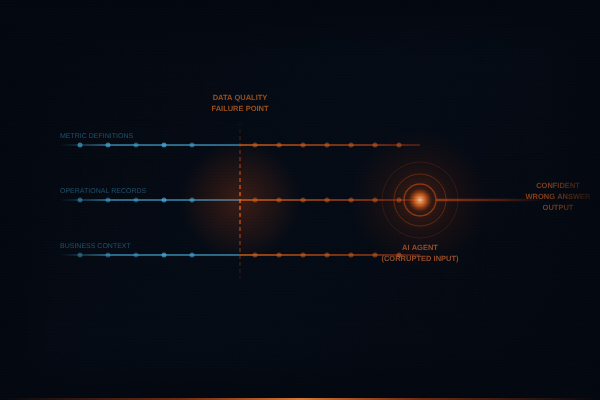
This is the master data problem, and it is not new. Organizations have been trying to solve it for decades through manual data cleaning, governance processes, and integration projects. The reason it matters specifically for AI now is that AI agents and models reason over data at a scale and speed that magnifies data quality problems in ways that human-driven processes did not. A human analyst reading a report can recognize that two customer records probably refer to the same person and make a judgment call. An AI agent querying the same data will treat them as different customers, produce analysis based on that incorrect assumption, and take actions downstream based on the error. At the scale and speed AI operates, bad master data does not just produce wrong answers occasionally. It systematically degrades every output the AI produces.
Reltio's platform uses AI-based entity resolution to identify and merge related records from multiple systems into curated master profiles, creating what the company calls a golden record, a single authoritative context-rich version of each core entity that AI systems can reason over reliably. Once integrated, SAP customers will be able to rely on trusted, high-quality data across SAP and non-SAP sources that Joule and Joule Agents use to deliver faster time-to-value for business AI.
The strategic logic is explicit. SAP's Business Data Cloud strategy will be extended by this acquisition, strengthening its ability to harmonize data across both SAP and non-SAP environments and expose that data through governed data products. What SAP is building is not just a better ERP. It is the data infrastructure layer that makes enterprise AI reliable regardless of which AI tools sit on top of it.
The Signal Every Non-SAP Organization Should Read
The SAP-Reltio deal is being covered primarily as an enterprise software story. The more important reading of it is as a signal about what the primary bottleneck for enterprise AI actually is.
SAP recognizes that the true power of AI lies not just in algorithms, but in the quality and accessibility of the underlying data. That recognition did not come from a research paper. It came from watching hundreds of thousands of enterprise customers deploy AI and discover that the models perform well in demos and poorly in production, and that the gap between those two experiences is almost always a data quality problem rather than a model quality problem.
This pattern is confirmed across the most rigorous enterprise AI research of 2025 and 2026. The number one blocker for enterprise AI deployment, cited by 58% of CXOs in Mayfield's 2026 survey, is data readiness and quality, and this is the fifth consecutive year that data quality has outranked all other concerns. Stanford's 2026 AI Index found that 88% of organizations use AI but fewer than 10% have scaled it in any single business function. The MIT GenAI Divide research found that 95% of enterprise AI pilots fail to deliver measurable P&L impact. In each case, the research points to the same underlying cause: organizations are deploying capable AI models on top of data infrastructure that cannot support reliable AI outputs at scale.
SAP has now made a $1.7 billion bet that solving this problem is the most valuable thing it can do for its customers. That bet is not a guess. It is informed by SAP's direct observation of where enterprise AI value is being blocked across its entire customer base.
Enterprises that establish unified, AI-ready data platforms by late 2026 will enter 2027 with deployment capabilities that competitors cannot quickly replicate. Those that delay face the prospect of 18-month catch-up cycles while markets continue accelerating. That competitive framing is not specific to SAP customers. It applies to any organization where AI deployment is running ahead of data infrastructure maturity.
What Marriott Understood That Most Organizations Have Not
SAP is not the only organization making this bet. Marriott's announcement in February 2026 committed more than a billion dollars in capital expenditure to rebuild its technology infrastructure for the AI era, with a significant share directed at rebuilding its property management system, its central reservation system, and constructing what the company described as a shared intelligence layer for AI.
Marriott's leadership framed the investment explicitly as a prerequisite for AI rather than a consequence of it. The shared intelligence layer is not a deployment of AI. It is the data foundation that AI will run on. The company recognized that its existing data infrastructure could not support the agentic AI capabilities it wanted to deploy, and it committed the capital to fix that before scaling the AI.
This sequencing of data foundation first and AI deployment second is the pattern that appears consistently in the organizations generating measurable AI returns. It is the inverse of the sequencing that most organizations have followed, which is to deploy AI tools first and address data infrastructure as problems emerge in production.
The cost of the inverted sequence is not just the remediation work required when data problems surface. It is the opportunity cost of AI capability that cannot be trusted and therefore cannot be scaled. Organizations that deployed AI before their data was ready have agents they cannot trust, outputs they cannot rely on, and returns they cannot demonstrate. Rebuilding the data foundation under a deployed AI system is significantly more disruptive and expensive than building it before deployment.
What This Means for Organizations Not Running SAP
The SAP-Reltio acquisition creates a specific dynamic for SAP customers that their IT and procurement teams need to evaluate. Forrester's response was immediate and pointed: SAP's Reltio Acquisition Forces a Choice for CIOs, not a recommendation but a choice with long-term architectural consequences. SAP customers now need to assess their master data governance approach against SAP's AI direction and determine whether the Reltio integration changes their data architecture roadmap.
But the more broadly applicable lesson from the acquisition is not about SAP's product strategy. It is about the fundamental prerequisite for enterprise AI that SAP's decision confirms: data readiness is not a technical detail. It is the primary determinant of whether AI investment produces enterprise returns.
For organizations not running SAP, the question the acquisition raises is identical: is our enterprise data clean, unified, and governed well enough to support reliable AI outputs at scale? The answer for most organizations is no, and the gap between the current state and AI-ready data is not closed by deploying better models. It is closed by doing the data governance, unification, and quality work that makes the models reliable.
Enterprises typically spend 23% of their IT budgets on integration projects. A unified platform that reduces this overhead by even 30% creates substantial customer value. The data integration and governance work is expensive regardless of whether an organization approaches it through a platform like Reltio, through internal investment, or through a combination. The question is not whether to do it. It is whether to do it before or after discovering that AI cannot scale without it.
The KAIDATA Lens
SAP's acquisition of Reltio is the most visible recent confirmation of something that has been consistent across enterprise AI research for two years: the organizations generating real AI returns are the ones that treated data infrastructure as the first investment, not the last.
KAIDATA's work with clients begins at exactly this point. Before evaluating AI tools, before selecting vendors, before designing agent workflows, the foundational question is whether the data those tools will operate on is trustworthy enough to support the outputs the business is counting on. For most organizations, the honest answer to that question requires a data readiness assessment rather than an assumption.
The value of doing that work before AI deployment rather than after is precisely what SAP has now quantified by spending over a billion dollars to acquire a company that does it. The difference for mid-market and enterprise organizations is that they do not need to spend a billion dollars to get there. They need a rigorous, structured approach to understanding where their data quality gaps are, which ones block the AI use cases they most want to deploy, and what it takes to close those gaps before deployment makes the cost of addressing them significantly higher.
That is the work that separates the 10% of organizations that have scaled AI from the 90% that have not. SAP's bet confirms what the evidence has been showing throughout 2026. The bottleneck for enterprise AI is not the AI. It is the data underneath it.