What Happened and Why It Matters Beyond the Headlines
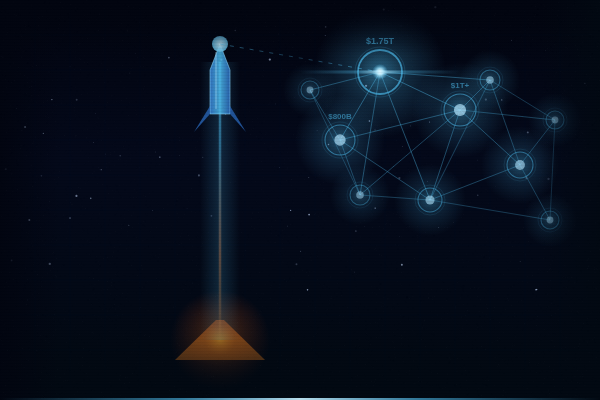
On June 12, 2026, SpaceX began trading on Nasdaq under the ticker SPCX, pricing at $135 per share and opening at $150, giving the company one of the largest IPO valuations in history at $1.75 to $1.8 trillion. The offering raised roughly $75 billion, making it among the largest public market transactions ever completed. Goldman Sachs President John Waldron, whose firm led the underwriting syndicate, called the debut evidence that capital markets are practically tripping over themselves to fund AI infrastructure at unprecedented scale.
The market reaction confirmed the thesis. SpaceX closed its first day of trading up roughly 19 to 25% from its IPO price, with early investor demand described as a frenzy. Saudi Arabia's Public Investment Fund alone was in talks to commit $5 billion. The message from the public markets was clear: AI infrastructure, at the right scale and with sufficient execution credibility, commands valuations that pure software companies struggle to match.
But SpaceX is not primarily a rocket company anymore. The February 2026 merger with Elon Musk's AI company xAI at a combined $1.25 trillion valuation means the entity that just debuted on Nasdaq is as much an AI infrastructure play as a space company. The xAI division, which includes the Colossus data center and Grok models, contributed $3.2 billion in revenue in 2025 and is consuming significant capital for data center buildout. Starlink, the profitable satellite internet division, provides the distribution layer that makes AI edge computing at planetary scale a credible long-term business.
Analysts are now saying openly what has been implied in AI investment conversations for months: Anthropic and OpenAI are likely to also list with valuations above $1 trillion each. The IPOs, when they arrive, will infuse fresh cash into both companies and signal the moment when enterprise AI's primary beneficiaries become accountable to public market shareholders. That accountability shift has direct and specific implications for enterprise buyers.
The Valuation Thesis and What Backs It
SpaceX's $1.75 trillion valuation requires examination before drawing conclusions about what it signals for the broader AI infrastructure market.
The company posted a GAAP net loss of $4.94 billion for full-year 2025 and a $4.28 billion loss in Q1 2026 alone, with an accumulated deficit of $41.3 billion. Morningstar initiated coverage with a fair value estimate of $780 billion, less than half the IPO valuation, with analyst Nicolas Owens stating clearly that the company is significantly overvalued. Morningstar's three scenario analysis found that in the most optimistic case, AI infrastructure creates approximately $1.3 trillion in value with a 7% probability, while the probability of the AI infrastructure business being shelved is 43%.
That analytical divergence is the most important data point for enterprise buyers to internalize. The SpaceX debut is not a verdict on whether AI infrastructure creates extraordinary value. It is a verdict on what the public markets are currently willing to pay for the option on that value materializing. Goldman Sachs' Waldron framed it accurately: the capital markets are willing to bankroll the AI buildout. They are not guaranteeing the returns.
The distinction matters because the AI infrastructure investment wave that SpaceX's IPO validates is precisely what is driving the enterprise pricing dynamics we have been documenting throughout 2026. The $600 billion in compute commitments that OpenAI has contracted, the $300 billion Oracle partnership, the $40 billion Google-Anthropic deal, the $6 billion Snowflake-AWS agreement: these are all obligations structured on the assumption that AI enterprise revenue will grow to justify the infrastructure investment. The public market appetite for AI infrastructure that the SpaceX IPO demonstrates is the same appetite that has funded those commitments. The question of whether the revenue follows is the same question enterprise buyers are watching unfold in their own vendor relationships.
What the Anthropic and OpenAI IPOs Will Actually Change
The SpaceX debut is a preview of the accountability shift that the Anthropic and OpenAI IPOs will create when they arrive, and that shift has direct implications for enterprise buyers that most procurement teams have not yet processed.
Private companies can absorb below-cost enterprise pricing as a market share strategy because their losses are funded by venture capital that is betting on long-term dominance. Public companies answer to shareholders quarterly. The moment Anthropic and OpenAI list at $1 trillion-plus valuations, they face investor expectations that prioritize gross margin improvement, path to profitability, and sustainable pricing rather than subsidized growth. The price increases enterprise buyers have already experienced through 2026 are the preview of that transition. The IPOs will accelerate it.
If SpaceX prices at the top of its range and trades up from there, expect a cascade of follow-on offerings. That cascade will bring not just additional capital but additional accountability. Public market analysts will scrutinize OpenAI's negative 122% operating margin in the same way they have scrutinized every other pre-profitability technology company that went public. The pressure to improve that margin will be transmitted directly into enterprise pricing decisions, support investment priorities, and product roadmap choices.
For enterprise buyers, this means the vendor relationship dynamics of 2025 and early 2026 will not persist. The subsidized, relationship-building pricing era is ending not just because of competitive dynamics but because the companies providing AI capability are moving into a financial environment that does not support subsidized pricing. The SpaceX IPO is the public market's confirmation that AI infrastructure has arrived as a legitimate asset class. The price that enterprise buyers pay for AI is the revenue side of that asset class. Those prices will be set by shareholders, not by competitive generosity.
The Sovereign Wealth Angle Nobody Is Talking About
One of the most consequential dimensions of the SpaceX IPO, and by extension the Anthropic and OpenAI IPOs to come, is where the capital is coming from and what it comes with.
Saudi Arabia's Public Investment Fund alone is in talks to put in $5 billion. ChatGPT, Claude, and Grok, three of the most widely used AI tools in the US, are all partly funded by Middle Eastern governments. Unlike venture capital, sovereign wealth comes with conditions, and those conditions almost always involve building AI infrastructure on the investing country's own soil.
For enterprise buyers who are building AI strategy around specific vendor relationships, the provenance of the capital funding those vendors is a supply chain consideration that deserves the same scrutiny applied to any other strategic vendor. The AI tools that US companies use daily are partly funded by sovereign wealth funds whose conditions include data center buildout in their home countries. The data residency, sovereignty, and compliance implications of that funding structure are not fully understood by most enterprise procurement teams.
This is a topic that will receive significantly more attention as the IPO filings for Anthropic and OpenAI disclose their investor structures to public scrutiny. Enterprise buyers in regulated industries should begin assessing their AI vendor data practices against these sovereign funding relationships before the disclosure requirements of public market listing make the conversation more urgent.
What This Means for Enterprise AI Strategy in the Second Half of 2026
The SpaceX IPO and the AI infrastructure valuation wave it represents change the strategic context for enterprise AI buyers in three specific ways.
First, the cost trajectory of enterprise AI is structurally locked in an upward direction. The $1.75 trillion valuation of SpaceX, the anticipated trillion-dollar-plus valuations of Anthropic and OpenAI, and the massive infrastructure commitments that underpin all three are all premised on enterprise AI revenue growing significantly from current levels. That growth will be extracted from enterprise buyers through the pricing dynamics we have documented throughout 2026. Organizations that model their AI costs assuming current pricing persists are building on incorrect assumptions.
Second, multi-provider architecture is no longer optional for any organization with a meaningful AI investment. The convergence of pricing pressure, sovereign funding complexity, and IPO-driven margin requirements creates a vendor risk profile that concentration in any single AI provider cannot adequately address. The organizations that will manage through the second half of 2026 and the IPO cycle with the most strategic flexibility are the ones that built genuine multi-provider capability before the accountability shift forces pricing decisions that make switching more expensive.
Third, the data infrastructure layer is increasingly where enterprise AI value is being created and captured. Snowflake's 36% stock jump on enterprise AI demand and its $6 billion AWS partnership, reported the same week as the SpaceX IPO, tell the same story from a different angle: the enterprise AI winners are the organizations that built the data foundation that makes AI reliable in production. The public markets are validating infrastructure. Enterprise buyers need to be investing in it.
The KAIDATA Perspective
The SpaceX IPO is a signal, not a verdict. It confirms that capital markets believe AI infrastructure will create enormous value. It does not confirm the distribution of that value or the timeline for realizing it. Morningstar's 43% probability that the AI infrastructure buildout does not materialize as projected is not pessimism. It is a disciplined assessment of execution risk at a scale and pace that has no precedent.
For enterprise leaders, the relevant response to this week's news is neither the enthusiasm of public market investors nor the caution of Morningstar analysts. It is the same disciplined question that has produced the best enterprise AI outcomes throughout 2026: are we building the foundational infrastructure that generates returns regardless of which vendor wins the AI infrastructure race?
The organizations generating real AI returns in 2026 are not primarily betting on vendor outcomes. They are building data infrastructure that is not vendor-specific, governance frameworks that apply across models, and workflow designs that generate measurable business value independent of which AI lab is leading the benchmark charts. Those foundations are valuable whether the AI infrastructure IPO wave creates the returns its proponents project or produces the correction its critics anticipate.
That is the work KAIDATA exists to support. The IPO wave will reshape the vendor landscape over the next 12 to 18 months in ways that are difficult to predict precisely. The foundational work that insulates enterprise organizations from that uncertainty is not difficult to define. It is the same foundational work that has always determined whether AI investment produces enterprise returns or enterprise activity.
The SpaceX debut confirmed that capital is flowing into AI infrastructure at historic scale. What it cannot confirm is whether your organization's AI investment is positioned to benefit from that infrastructure or simply pay for it. That determination is still made at the organizational level, one data governance decision and one workflow design at a time.