The Spending Is Real. The Returns Mostly Are Not.
Enterprise AI spending crossed $300 billion in 2025 and is on pace to reach roughly $407 billion in 2026, according to IDC's Worldwide Artificial Intelligence Spending Guide. By any measure, the appetite for AI investment has never been higher. Boards are approving budgets, executives are announcing initiatives, and nearly 78 percent of enterprises report having adopted AI in at least one business function.
The results tell a much less impressive story. MIT's GenAI Divide research, based on 150 executive interviews and an analysis of 300 public AI deployments, found that roughly 95 percent of enterprise generative AI pilots fail to deliver measurable impact on profit and loss. S&P Global reported that 42 percent of companies abandoned most of their AI projects in 2025. IBM put the number of initiatives that actually delivered the ROI they promised at 25 percent. Morgan Stanley found that only 21 percent of S&P 500 companies could point to a single measurable AI benefit.
This is not a story about AI failing as a technology. The models work. The gap is between companies buying AI and companies that can actually run it inside a workflow people trust. The companies pulling ahead are rarely the ones with the most advanced model. They are the ones that did the unglamorous work first.
Why the Flashy Pilot Stalls Out
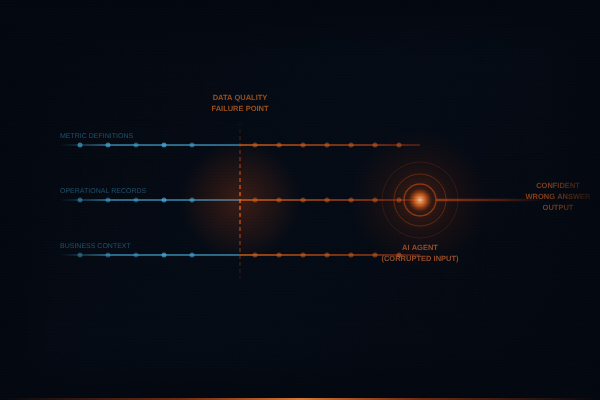
Gartner's research on stalled AI projects is specific about where things break down. Forty four percent of AI projects never make it past the pilot stage, and the top reasons are unclear business objectives, poor data quality, and lack of executive sponsorship, in that order. Notice that none of those reasons are about the AI model itself. They are about the conditions surrounding it.
A pilot is built to impress a room. It runs on a curated dataset, a narrow use case, and a demo script that avoids the messy edge cases. None of that resembles the real environment the tool eventually has to operate in, where data lives across 897 disconnected applications on average, according to enterprise integration research, with only about 28 percent of those systems actually connected to each other. The AI was never the hard part. Getting clean, connected, trustworthy data in front of it is.
This is also why costs blow past projections so often. Fifty eight percent of enterprises report that AI infrastructure costs exceeded initial estimates by 40 percent or more, primarily because teams underestimated what it would actually take to prepare and maintain the data feeding the system. The flashy part of the project gets the budget approval. The boring part is what determines whether the project survives contact with reality.
What the Companies Seeing Real ROI Are Doing Differently
The pattern among the minority of companies actually capturing returns is consistent and unglamorous. Fivetran's 2026 enterprise data infrastructure benchmark found that organizations using fully managed, well maintained data pipelines are nearly twice as likely to exceed their ROI targets compared to those running on fragile, manually maintained integrations, 45 percent versus 27 percent. That gap has nothing to do with which AI vendor they chose.
CIO.com's reporting on enterprise AI readiness echoes the same finding from a different angle. Only about a third of organizations report broad or strong ROI from AI, and the companies seeing it consistently share one trait, their underlying data environment was already mature before the AI layer was added. The returns show up first in the workflows that already had clean, structured, well governed data behind them, not in the flashiest new use case.
There is a measurement gap underneath all of this that rarely makes the headlines. A 2025 survey of bank directors found that 82 percent of financial institutions do not measure ROI on any technology investment, AI included. You cannot prove a project is working, and you cannot defend its budget at renewal time, if there was never a baseline to measure against. Reporting infrastructure is not a nice to have layered on top of AI. It is the thing that tells you whether any of it is working at all.
The Real Work Happens Before the AI Gets Involved
None of this is an argument against AI investment. It is an argument against sequencing it backwards. The companies winning right now built three things before they scaled anything, a way to measure whether tasks were actually working, infrastructure that connected those tasks into a workflow people could rely on, and a habit of checking the data behind it on a recurring basis rather than once at launch.
That is not a technology problem most executives think they have. It looks like a marketing operations problem, a reporting problem, or a data hygiene problem, which is exactly why it gets deprioritized in favor of the more exciting AI headline. But the executives who are seeing real returns are the ones who treated the boring layer as the actual project, with the AI tool as the thing that finally got to take advantage of a foundation that was already solid.
How KAIDATA Approaches This
This is the work we do at KAIDATA before any flashy initiative gets greenlit. We start by auditing what the data actually looks like across a company's marketing and reporting systems, where it is duplicated, where it is disconnected, where the numbers in one dashboard quietly disagree with the numbers in another. We build reporting infrastructure that gives leadership a single, trustworthy source of truth before adding any layer of automation or AI on top of it.
That ordering matters. A company with disciplined reporting and clean data can adopt a new AI tool in weeks and see the return show up in the next quarter's numbers. A company that skips straight to the AI tool usually spends the next year discovering why the output cannot be trusted. We have built that foundation work for clients across four different companies simultaneously, and the lesson holds every time, the unglamorous part is the part that actually determines the ROI.
If your AI initiatives are stalling, the fix is rarely a better model. It is usually upstream of the model entirely.