The Most Important Statistic Nobody Is Talking About
Every week produces a new headline about enterprise AI adoption. The numbers are consistently impressive. According to the Stanford Institute for Human-Centered AI's 2026 AI Index report, one of the most comprehensive and rigorously sourced analyses of AI's state published this year, 88% of organizations now use AI in at least one business function. Generative AI reached 53% global population adoption in just three years, faster than the personal computer and faster than the internet at comparable stages of development.
These numbers are real. They are also deeply misleading if you stop there.
The statistic that does not get the same headline treatment is this one: fewer than 10% of organizations have fully scaled AI in any single business function. That is the Stanford report's own finding. 88% have adopted. Fewer than 10% have scaled. The gap between those two numbers is where most enterprise AI investment is currently disappearing.
For C-suite leaders, this is the most operationally relevant data point in a 400-page report full of them. The question is not whether your organization is using AI. If you are in the 88%, you already are. The question is whether it is operating at a level that produces reliable, measurable, enterprise-scale returns, or whether it is running in the margins of how your business actually works, useful in isolated applications and invisible on the P&L.
What the Stanford Data Actually Shows
The Stanford 2026 AI Index is notable for the precision with which it distinguishes between AI presence and AI performance. Most adoption metrics count any reported use of AI within an organization. A team using ChatGPT to draft emails counts. An AI-generated summary in a weekly report counts. A customer service chatbot that handles basic queries counts. All of these show up in the 88%.
What does not show up in that 88% is whether any of it is producing the operational outcomes that justified the investment. Stanford's data on that question is unambiguous. Actual AI agent deployment sits in single digits across nearly all business functions. The productivity gains that are being documented are real but narrow: studies cited in the report show gains of 14 to 15% in customer support, 26% in software development, and 50% in marketing output. But the report also notes that these gains are smaller in tasks requiring deeper reasoning, and that heavy AI reliance may carry long-term learning penalties that slow skill development over time.
The investment picture makes the adoption gap even more striking. Global corporate AI investment reached $581.7 billion in 2025, a 130% increase in a single year. US private AI investment reached $285.9 billion. The estimated value of generative AI tools to US consumers reached $172 billion annually by early 2026. The financial commitment to AI is historic in scale. The operational maturity required to convert that investment into durable enterprise returns is lagging significantly behind.
The Risk Signal Most Organizations Are Missing
One of the most consequential findings in the Stanford report for enterprise leaders is the trajectory of AI risk perception. 74% of respondents in McKinsey's annual survey, cited in the Stanford report, now identify inaccuracy as their top AI concern. That figure is up 14 percentage points in a single year, making data quality the number one risk ahead of cybersecurity at 72%, regulatory compliance at 63%, and privacy at 54%.
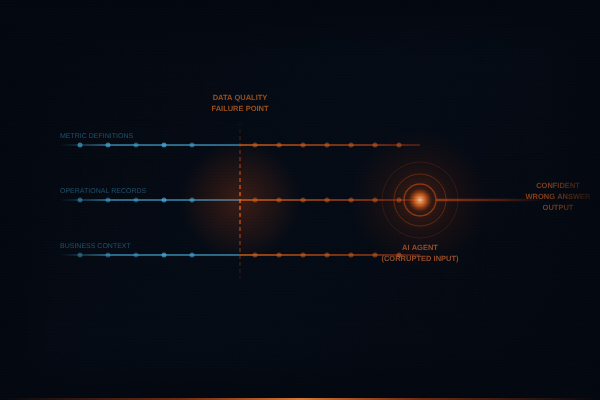
This shift matters because it reflects a real operational experience. Organizations that deployed AI without adequate data governance infrastructure are encountering the consequences in production. Stanford's assessment of hallucination rates across 26 leading foundation models found a range spanning from 22% to 94%. Even the best-performing models produce inaccurate outputs roughly one in five times. When AI is operating in workflows that lack validation layers, audit trails, and quality controls, those error rates are not theoretical. They are showing up in customer outputs, financial reports, and operational decisions.
The Foundation Model Transparency Index, also cited in the Stanford report, fell from 58 to 40 points in the past year, meaning the most capable AI models are providing less visibility into how they work, not more. As models become more powerful, they are also becoming harder to audit. For organizations operating without formal governance frameworks, this trajectory creates a compounding risk that grows with every deployment.
Why the Adoption Gap Exists and Why It Persists
The gap between 88% adoption and sub-10% scale is not a mystery. It follows directly from a sequencing problem that has characterized most enterprise AI investment since 2023: organizations have been deploying AI before building the infrastructure that makes AI reliable at scale.
Stanford's report documents this with a specificity that is worth unpacking. The problem is not model capability. The models are genuinely extraordinary. On SWE-bench Verified, one of the most demanding coding benchmarks, AI performance rose from 60% to near 100% of the human baseline in a single year. Models are now matching or exceeding human performance on PhD-level science questions, competition mathematics, and multimodal reasoning. The technology has advanced faster than most enterprise AI roadmaps anticipated.
The problem is what sits beneath the models in an enterprise deployment: the data infrastructure, the integration architecture, the governance frameworks, the quality validation systems, and the organizational change management that determines whether a capable model produces reliable enterprise-grade outputs or produces the confident errors that are driving the 14-point surge in accuracy concerns.
A model that performs well on a benchmark or in a pilot can still struggle with customized processes, fragmented data, exception-heavy workflows, and regulated operating conditions. Stanford's data team put this directly in their analysis: AI use is expanding faster than operational maturity. Organizations are applying AI in workflows before establishing controls, creating uneven outcomes as usage scales.
The Shadow AI Problem Underneath It All
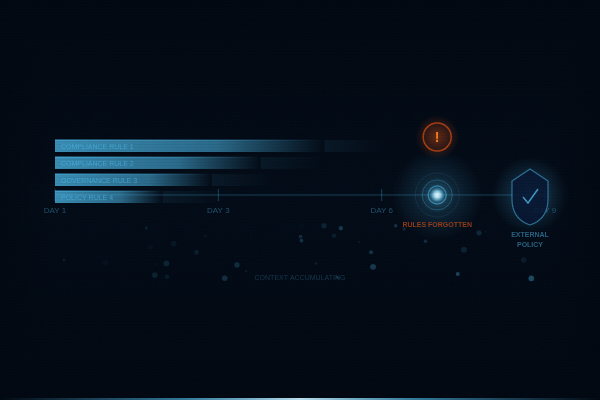
One dimension of the adoption gap that the Stanford report surfaces with particular relevance for governance-focused leaders is the scale of unsanctioned AI use. The finding that 88% of organizations are using AI does not mean 88% of organizations have made deliberate decisions to deploy AI. In many cases, it means employees are using AI tools independently, through personal accounts, on workflows their organization has not evaluated, governed, or even acknowledged.
Stanford's data on employee AI use makes the governance urgency concrete. Four out of five university students now use generative AI for school-related tasks. Only half of middle and high schools have AI policies in place, and just 6% of teachers say those policies are clear. The same dynamic is playing out inside most enterprises: tools are in active use, but the policies, guardrails, and accountability structures required to make that use defensible are not keeping pace.
When a cyber insurance carrier, auditor, or board member asks how AI is governed in your organization, the answer that 88% adoption makes possible is not actually reassuring. The relevant answer is whether the AI operating inside your organization is doing so with appropriate data controls, output validation, and audit trails, and for most organizations in the current Stanford data, it is not.
The Path From Adoption to Scale
Stanford's report is not pessimistic about enterprise AI. The data on productivity gains is real, the investment trajectory is historic, and the capability improvements are genuinely extraordinary. What the report describes is an operational readiness problem, not a technology problem, and operational readiness problems have known solutions.
The organizations that have crossed from the 88% into the sub-10% share a consistent set of characteristics. They prioritized data infrastructure before model deployment. They built governance frameworks before they encountered the incidents that make governance urgent. They measured AI performance against specific business outcomes rather than tracking deployment activity. They assigned cross-functional accountability for AI results. And they treated AI adoption as an organizational transformation with change management requirements, not a technology project with a go-live date.
This is, at its foundation, a data and governance problem before it is an AI problem. The organizations generating consistent, measurable returns from AI investment are not the ones with access to better models. They are the ones that built the data architecture, quality controls, and operational frameworks that make capable models reliable in production environments. The Stanford data is explicit: the primary barrier to scaling AI is not the AI. It is the infrastructure underneath it.
That is a problem that requires a specific kind of expertise to solve, and it is exactly the work that KAIDATA is built for. The adoption gap documented in Stanford's 2026 report is not inevitable. It is the predictable outcome of skipping foundational work in a rush to deploy. Closing it requires starting where most organizations have not yet started: with the data, the governance, and the organizational design that makes everything built on top of it worth building.
The 88% statistic is a starting line. The sub-10% who have scaled it have earned the advantage. The distance between those two positions is not primarily a technology gap. It is a strategy and infrastructure gap. And it is one that organizations have a defined window to close before the advantage of those who got it right compounds further out of reach.