A $200 Million Signal You Should Not Ignore
On February 2, 2026, Snowflake and OpenAI announced a multi-year, $200 million partnership aimed at one specific goal: deploying autonomous AI agents across global enterprises at scale. The deal makes OpenAI's frontier models, including GPT-5.2, natively available inside Snowflake's AI Data Cloud for the company's 12,600 customers. It means organizations can now build and deploy AI agents that reason over their proprietary data, execute complex workflows, and surface decisions in natural language, all without that data ever leaving the governed Snowflake environment.
This is not a product announcement. It is a structural signal. When two companies of this scale commit $200 million to a single technology category and frame it explicitly around enterprise deployment rather than research or experimentation, it tells you where the next phase of enterprise AI is actually headed.
Sridhar Ramaswamy, CEO of Snowflake, framed it directly: "Customers can now harness all their enterprise knowledge in Snowflake together with the world-class intelligence of OpenAI models, enabling them to build AI agents that are powerful, responsible, and trustworthy." Fidji Simo, CEO of Applications at OpenAI, added that the deal is designed to help organizations "close the gap between what AI is capable of and the value they can create today."
That gap, and what it takes to close it, is precisely what C-suite leaders need to understand right now.
What Agentic AI Actually Is
Most enterprise AI deployments to date have been reactive. You ask the system a question, it generates an answer. You prompt it, it responds. Generative AI in this mode is a productivity tool, valuable, but fundamentally passive.
Agentic AI is different in a meaningful way. An AI agent does not wait for a prompt. It perceives its environment, sets goals, plans a sequence of steps, executes across multiple systems and data sources, and completes tasks with limited or no human intervention at each stage. It can query a database, send a communication, update a record, trigger a workflow, flag an anomaly, and hand work off to another agent, all within a single task chain.
In practice, this means an AI agent in a finance operation can identify discrepancies in invoicing data, cross-reference contract terms, flag exceptions that require human review, and route routine approvals automatically, without a human orchestrating each step. In customer operations, an agent can handle a refund request end-to-end, checking eligibility, processing the transaction, logging the interaction, and generating a follow-up, with a human only stepping in when the situation falls outside defined parameters.
Gartner describes the shift plainly: agentic AI is evolving "from tools that assist humans to platforms that replace manual effort for complex workflows." By 2028, Gartner projects that at least 15% of day-to-day work decisions across enterprises will be made autonomously through agentic AI, up from essentially zero in 2024.
The Pace of Adoption Is Accelerating Faster Than Most Realize
The speed at which agentic AI is moving from concept to enterprise infrastructure is one of the defining characteristics of 2026. Gartner forecasts that 40% of enterprise applications will be integrated with task-specific AI agents by the end of this year, up from less than 5% in 2025. That is an eightfold increase in enterprise application integration in a single year.
McKinsey's research found that 23% of organizations are already scaling an agentic AI system somewhere in their business, and another 39% are actively experimenting. More than half of surveyed organizations are at minimum testing the agentic model. The AI agent market itself is projected to exceed $10.9 billion in 2026, growing at over 45% annually.
The Snowflake-OpenAI partnership is one part of a broader consolidation happening at the infrastructure layer. Snowflake had previously announced a separate $200 million partnership with Anthropic in December 2025, bringing Claude models into the same governed environment. The pattern is clear: the major data platforms are racing to embed frontier AI models directly into the layer where enterprise data already lives, removing the friction of moving data to external AI services and eliminating the governance and compliance barriers that have slowed adoption in regulated industries.
Where Deployment Is Already Delivering Results
Early production deployments are generating documented results across several business functions. Customer service operations using AI agents are reporting time savings of 40 or more hours per month for small teams. Finance and operations teams automating invoicing, forecasting, and expense auditing are accelerating close processes by 30 to 50%. Sales and marketing organizations deploying lead qualification and outreach agents are documenting two to three times improvements in pipeline velocity.
Among early adopters who have built the right foundational architecture, the average reported ROI from agentic AI deployment is 171%, according to survey data from PagerDuty. U.S. enterprises are forecasting even higher returns at 192%. These are not theoretical projections built on vendor benchmarks. They reflect organizations that got the deployment fundamentals right and built from there.
Why Most Organizations Are Not Ready
Here is where the news gets more complicated. The same research that documents these results also documents a systemic readiness gap that will determine which organizations capture this opportunity and which spend the next two years cleaning up failed deployments.
Gartner's prediction is stark: over 40% of agentic AI projects will be canceled by the end of 2027 due to escalating costs, unclear business value, or inadequate risk controls. The senior director analyst at Gartner framing this prediction put it directly: "Most agentic AI projects right now are early stage experiments or proof of concepts that are mostly driven by hype and are often misapplied. This can blind organizations to the real cost and complexity of deploying AI agents at scale."
Deloitte's 2026 enterprise AI research adds a useful data point: 42% of companies believe their AI strategy is highly prepared for the next phase of adoption, but only 30% say the same about their risk and governance capabilities. Strategy confidence is outrunning operational control. That gap is one of the most reliable predictors of project failure.
The Four Layers You Need Before Agents Can Work
Analysis of early enterprise agentic AI deployments reveals a consistent pattern. Projects are not failing because the technology lacks capability. They are failing because organizations start deploying before the foundational layers that support autonomous workflows are in place.
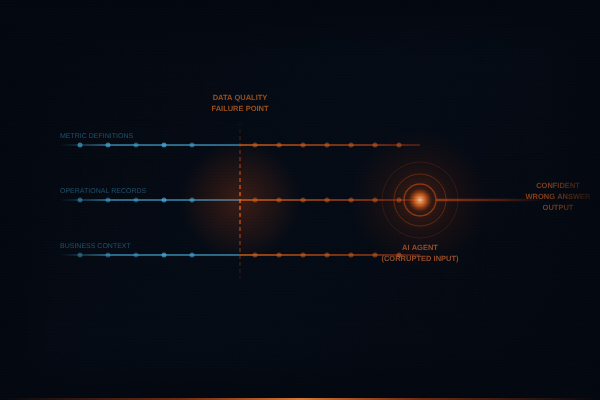
Those layers are specific. First, data architecture: agents execute multi-step tasks across enterprise systems and require high-quality, structured, accessible data. Fragmented data pipelines do not just slow agent deployment, they corrupt it. An agent operating on inconsistent or incomplete data will make confident, systematic errors at a scale and speed that manual processes never could.
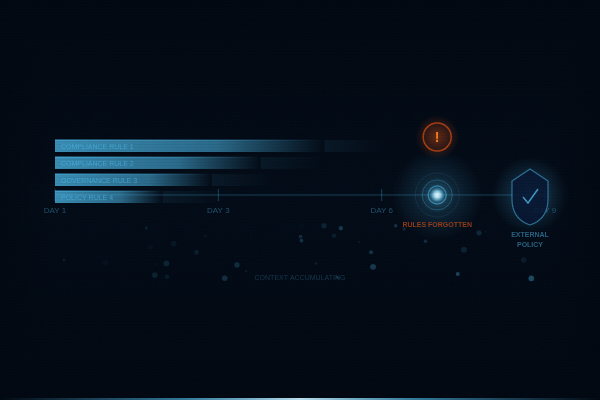
Second, governance: organizations need clearly defined parameters for what agents are permitted to do, what decisions they can make autonomously, what requires human review, and how agent actions are logged and auditable. In regulated industries, this is not optional. Without it, autonomous execution creates compliance exposure that outweighs the operational gains.
Third, orchestration: as organizations scale beyond a single agent to networks of agents working across workflows, coordination infrastructure becomes critical. Who governs how agents hand off work to each other? How are conflicts resolved? How is agent behavior monitored in production? These questions require answers before deployment, not after failure.
Fourth, human interface design: the most effective agentic deployments are not fully autonomous. They are structured around clear decision points where human judgment is required and well-designed handoff mechanisms that make escalation seamless. The goal is not to remove humans from the loop entirely. It is to ensure humans are focused on the decisions that actually require them.
The Governance Gap Is the Biggest Risk
Seventy-five percent of enterprise leaders cite governance and security as their primary challenge in agentic AI deployment, according to research from Straiker. Yet 96% of IT leaders plan to expand their AI agent implementations regardless. The gap between deployment ambition and governance readiness is the defining risk of the current moment.
This is compounded by what Gartner terms "agent washing," where vendors rebrand existing chatbots, robotic process automation tools, and basic assistants as agentic AI without building meaningful autonomy into the underlying system. Organizations evaluating agentic AI solutions need to distinguish between tools that genuinely plan and execute across systems and those that have simply been relabeled for a hotter market.
What C-Suite Leaders Should Be Doing Now
The organizations that will be positioned well by the end of 2026 are not necessarily the ones moving the fastest. They are the ones moving deliberately, building the foundational architecture that makes agentic deployment sustainable rather than launching agents into environments that cannot support them.
That means three things at the leadership level. First, assessing data readiness before selecting agent platforms. The Snowflake-OpenAI architecture is a good example of the direction the market is heading: agents that operate inside the governed data environment rather than requiring data to move to external tools. Before evaluating which agents to deploy, organizations need an honest picture of whether their data infrastructure can support autonomous multi-step execution reliably.
Second, building governance before it becomes urgent. Deloitte's finding that only one in five companies currently has a mature governance model for autonomous AI agents is a significant warning. As agentic AI moves into financial decisions, customer communications, and operational workflows, the accountability question becomes acute. Who is responsible when an agent makes an incorrect decision? How is that decision traced, corrected, and prevented from recurring? Governance frameworks need to be designed proactively, not assembled reactively after an incident.
Third, starting narrow and proving value before scaling. The documented failure pattern for agentic AI projects follows the same arc as failed AI pilots generally: broad ambition, weak scoping, unclear success metrics, and no defined path from proof-of-concept to production. The organizations reporting 171% ROI from agentic deployment are not the ones that launched the most ambitious agents first. They are the ones that identified specific, high-value, well-defined workflows, proved value, and built from there.
The agentic AI wave is not coming. It is here. The Snowflake-OpenAI deal, the Gartner forecasts, the production deployments already generating documented results, and the 40% cancellation rate for projects without the right foundation, these are all present-tense developments. The question for enterprise leaders is not whether to engage with this technology. It is whether the work needed to deploy it responsibly is happening at the same pace as the ambition to deploy it.
For most organizations right now, the honest answer is no. And closing that gap is the strategic priority of 2026.