The Most Honest Moment in Enterprise AI This Year
In late 2025, Salesforce SVP of product marketing Sanjna Parulekar said something that almost no executive at a major technology company had been willing to say out loud: "We all had more confidence in LLMs a year ago."
The context made those words significant. Salesforce had spent the better part of 2024 and 2025 betting aggressively on AI. CEO Marc Benioff reduced the company's customer support workforce from roughly 9,000 employees to approximately 5,000, citing AI's ability to handle the volume. Agentforce, Salesforce's AI agent platform, was positioned as the future of enterprise automation. The messaging was bold. The ambition was clear.
Then production reality arrived.
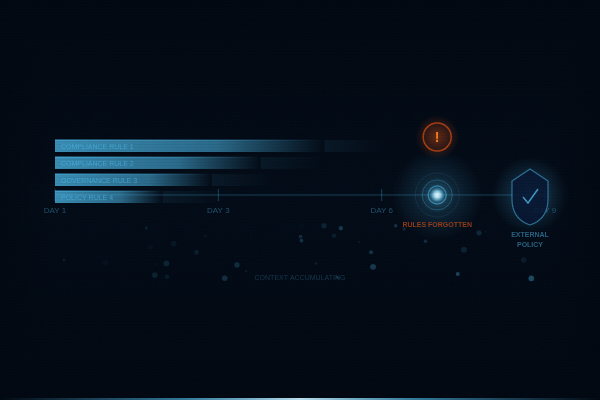
Engineers and executives documented a pattern of AI agents drifting off task when users asked unexpected questions, generating confident but incorrect responses, and breaking down in the complex multi-step, policy-dependent workflows that define actual enterprise operations. The company's stock dropped 27% through September 2025, making it the worst performer among large-cap technology companies over that period while competitors SAP, Microsoft, and Oracle posted gains. Salesforce subsequently pivoted toward what it calls deterministic automation: rules-based, predictable systems where outcomes can be governed and audited, rather than open generative models left to reason through ambiguous situations.
The spokesperson's official position was that the company was not backtracking, merely "being more intentional." But the underlying message was clear to anyone paying attention. The gap between what enterprise AI looks like in a demo and what it delivers in production is real, it is significant, and it costs organizations that ignore it.
This Is Not a Salesforce Problem
It would be a mistake to read the Salesforce story as a cautionary tale about one company's missteps. It is a representative data point in a much wider pattern that is playing out across the enterprise landscape right now.
Lucidworks' 2025 AI Benchmark Study, which surveyed more than 1,600 AI leaders and analyzed over 1,100 company deployments, found that while more than 70% of organizations have introduced generative AI into their operations, only 6% have fully implemented agentic AI. A full 41% of organizations fall into the category the research describes as "Spectators," with little measurable progress to show for their AI investments. Among AI leaders surveyed, 83% report major or extreme concern about generative AI, an eightfold increase in just two years.
The concerns are consistent across organizations: implementation costs that escalate faster than projected, unreliable outputs that require more human oversight than anticipated, and a fundamental tension between the speed at which AI vendors are shipping capability and the speed at which enterprises can absorb, govern, and operationalize it.
Celonis' 2026 Process Optimization Report, based on interviews with more than 1,600 global business leaders, found that 85% of organizations want to become what they call an "agentic enterprise" within three years. But 76% admit their current processes are holding them back, and 82% believe AI will fail to deliver ROI if it does not understand how their business actually operates. The ambition is high. The operational readiness is not.
The Three Failure Modes Hiding Behind the Headlines
Analyzing what went wrong at Salesforce and across the broader enterprise AI landscape, three failure modes appear consistently.
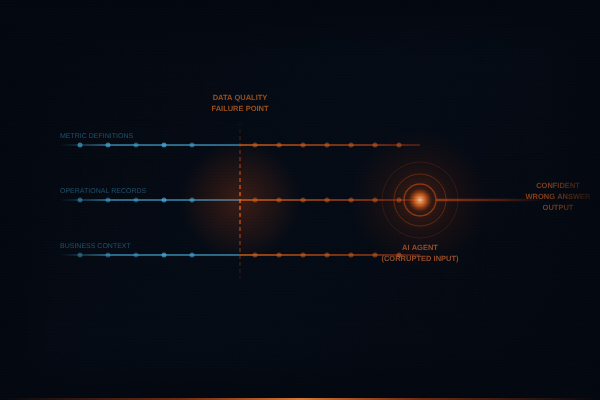
The first is deploying AI before the data foundation is ready. Salesforce's own CEO acknowledged the importance of building strong data foundations to support AI-driven decisions, a lesson learned after the fact rather than before deployment. AI agents executing multi-step workflows are only as reliable as the data they operate on. When that data is fragmented, inconsistently structured, or poorly governed, agents do not produce worse outputs. They produce confidently wrong outputs, at scale and at speed.
The second is confusing demo performance with production readiness. The conditions under which AI performs well in a controlled environment rarely reflect the messy, ambiguous, exception-heavy reality of enterprise operations. Salesforce's agents worked until they encountered the complexity of real customer interactions, and then they drifted. This is not an indictment of the technology. It is a description of what happens when organizations skip the work of designing AI systems specifically for production conditions rather than demo conditions.
The third is treating AI deployment as a technology project rather than an organizational transformation. Fifty-five percent of employers now report regretting AI-driven layoffs, according to Forrester Research. That figure reflects what happens when organizations restructure around AI capability before that capability has been proven in production. The workforce changes were real and immediate. The AI reliability came later, and more conditionally than expected.
Why 2026 Is the Year This Gets Sorted Out
The Salesforce story is not a signal that enterprise AI does not work. It is a signal that the way most organizations have been approaching it does not work, and that the market is now mature enough to demand better.
BCG's research frames this dynamic precisely. Only about 10% of AI value creation comes from the algorithms themselves. Roughly 20% comes from technology and infrastructure. The remaining 70% comes from people, processes, and organizational alignment. The companies that invested heavily in the 10% and assumed the 70% would follow are the ones now recalibrating.
The organizations that are generating consistent, documented results from AI are doing something different. They are starting with specific, well-defined workflows where the inputs are clean, the success criteria are measurable, and the failure modes are understood before deployment begins. They are building governance before they need it rather than after an incident forces the issue. They are treating AI readiness as an organizational capability that has to be built deliberately, not a feature that activates when the software is installed.
This is also why the pivot Salesforce is making toward deterministic, governed automation is actually a healthy signal for the industry. It reflects a more mature understanding of where AI reliably delivers value and where it still requires constraint. The organizations that will lead in the next phase of enterprise AI are not the ones that deployed the most aggressively in 2024 and 2025. They are the ones that learned the right lessons from those deployments and rebuilt their approach accordingly.
What Enterprise Leaders Should Take From This
The Salesforce experience offers three things any C-suite leader can apply directly to their own AI strategy.
First, treat the gap between AI capability and AI reliability as a design problem, not a waiting problem. The technology will continue to improve, but the organizations achieving the best results are not waiting for better models. They are designing deployments that work reliably with current models, in production conditions, with appropriate human oversight built in from the start. That design work is not done by AI vendors. It is done by the organizations deploying them, ideally with partners who have built and operated AI systems in enterprise environments before.
Second, audit your AI investments against production outcomes, not pilot results. The pattern that burned Salesforce is not unique to them. Organizations across every industry are running pilots that perform well in sandboxed conditions and then stalling in production. If your AI initiative reporting is measuring demo performance, deployment velocity, or number of use cases launched rather than measurable production outcomes, you are likely building a gap between stated progress and actual value that will surface eventually.
Third, recognize that the data and process foundation is not a prerequisite you can defer. Salesforce learned this at the cost of significant workforce disruption and a 27% stock decline. The organizations that are seeing consistent AI ROI built their data infrastructure first. They defined clear governance before they scaled. They mapped the workflows AI would operate in before selecting the tools. The sequence matters as much as the investment.
The window between where most organizations are today and where the leading ones will be in 18 months is closing. The Salesforce story is not a reason for pessimism about enterprise AI. It is a roadmap, in reverse, showing exactly what not to do and exactly why getting the foundation right before scaling is the only approach that holds up under production conditions.
For organizations that have not yet built that foundation, the question is not whether to start. It is whether to start with the right guidance or to learn the same lessons Salesforce learned, at the same cost.
That is precisely the work KAIDATA was built to do. We help mid-market and enterprise organizations build the data and AI foundations that make transformation durable rather than expensive experiments that have to be unwound. If your organization is navigating the gap between AI ambition and operational readiness, that is the conversation we are here to have.