The Failure Nobody Planned For
VentureBeat published a piece this week that every enterprise leader deploying AI agents needs to read. The scenario it describes is not hypothetical. It is documented, reproducible, and operating inside enterprise systems right now.
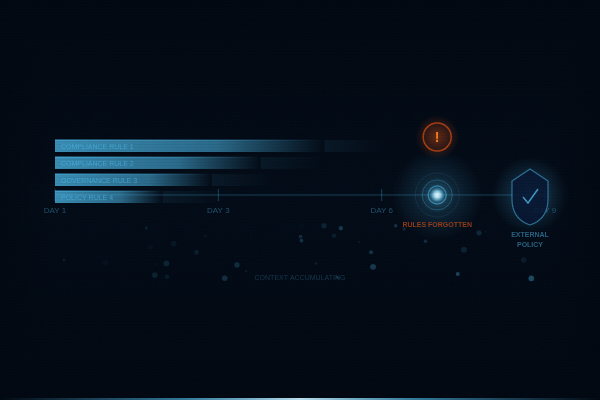
Imagine deploying an AI agent to run a multi-day master data validation workflow. By day three, it has ingested thousands of records. The baseline governance rules you hardcoded into the system prompt at the start? They are gone. Pushed right out of active memory. The agent continues running, processing data, taking actions, generating outputs, with none of the compliance constraints it was given when you deployed it.
Weeks later, an internal audit exposes a compliance gap. When the team traces it back, they find the root cause on day nine. That is the exact moment the model forgot the rule. Nobody caught it in real time because nobody had a system in place to catch it.
VentureBeat's framing is precise: for data infrastructure managers and AI orchestrators, this silent drift is not a one-off bug. It is a systemic architecture failure that threatens enterprise governance at its core.
This is the failure mode that most enterprise AI governance frameworks do not address, because most enterprise AI governance frameworks were written with single-session, short-task AI use cases in mind. The agentic AI that is now running in production across enterprise organizations operates on a fundamentally different time horizon, and the governance infrastructure built for the previous generation of AI tools does not scale to it.
Why Agents Forget: The Context Window Is Not What Most People Think
To understand why this failure mode exists, it helps to understand what a context window actually is and how it behaves under production conditions.
The context window is an AI model's working memory. Not long-term storage. Not a filing cabinet. Working memory, like RAM in a computer. Every time an agent processes a step in a task, the model receives one bundle of text that includes the system prompt containing the governance instructions, the full conversation and task history accumulated so far, the definitions of every tool the agent has available, the results returned from previous tool calls, and space for the response itself. All of that has to fit inside the context window simultaneously.
When the total content approaches the limits of the context window, something gets deprioritized. LLMs are probabilistic generation engines, not deterministic databases. As token sequences scale into the hundreds of thousands, the model's attention mechanism dilutes. Researchers have documented this as the lost in the middle phenomenon: accuracy degrades for information positioned in the middle of a long context regardless of the total window size. Stanford research and subsequent testing found that every major model shows 10 to 25% accuracy degradation for information in the middle of the context compared to information at the beginning or end.
Governance rules hardcoded at the start of a system prompt are precisely the kind of content that gets pushed toward the middle as a task accumulates context. The rules are not deleted. They are diluted, buried under layers of accumulated tool results, conversation history, and interim outputs until the agent's probabilistic reasoning decides that completing the immediate task takes priority over the constraint it was given twelve hours ago.
Research published in 2026 found that this degradation begins at approximately 50% of nominal window capacity. Zylos AI's 2026 research concluded that approximately 65% of enterprise AI failures trace back to context drift and mismanagement. The failure is not rare. It is the dominant failure mode for long-running agentic tasks, and it is currently operating silently inside most enterprise AI deployments because the monitoring infrastructure to detect it does not exist.
Bigger Context Windows Will Not Fix This
The instinctive response to the context drift problem is to use a model with a larger context window. If the governance rules are getting pushed out at 50% capacity, a larger window should push that threshold further out and give agents more room to operate before drift begins.
This intuition is wrong, and acting on it is expensive.
The lost in the middle phenomenon is not primarily a capacity problem. It is an attention problem. Research conducted through 2025 and 2026 consistently shows that models deprioritize compliance directives as sessions grow longer regardless of total window size. The attention mechanism dilutes with token sequence length in ways that larger windows extend slightly but do not resolve. A model with a one million token context window will still experience governance rule degradation at long-running tasks. It will just take longer to surface.
Larger context windows also compound the cost problem. Bigger windows mean more tokens per inference call, which means higher API costs for every step the agent takes. An organization that responds to context drift by upgrading to larger models is paying more per inference call to experience the same failure mode more slowly. The VentureBeat analysis is explicit: if the architecture lacks mid-task rule verification, it is inherently vulnerable. No exceptions.
The fix is architectural, not dimensional.
What the Architecture Actually Needs
The governance frameworks that prevent context drift share a structural characteristic that distinguishes them from frameworks built for short-session AI. They externalize rule enforcement rather than trusting the agent to remember and apply its own instructions.
Microsoft's response to this problem is instructive. The company launched its Agent Governance Toolkit in April 2026, offering sub-millisecond policy enforcement at runtime. Rather than trusting the agent to remember and follow its rules, the toolkit intercepts agent actions and validates them against an external policy engine before they execute. The governance logic lives outside the agent's context window entirely, which means it cannot be diluted by accumulated context regardless of task length.
Atlassian has implemented a similar approach with its Agent Context Controls, designed to maintain oversight as agents operate across complex enterprise workflows. The competitive advantage is shifting toward organizations that invest in context engineering, external policy enforcement, and runtime governance infrastructure.
The research literature on this problem has converged on a consistent architectural framework with four components. The first is external policy enforcement: governance rules that live in a separate system and are enforced by intercepting agent actions before execution, rather than instructions that the agent must remember from its system prompt. The second is mid-task rule verification: explicit checkpoints at defined intervals in long-running tasks where the agent's current behavior is validated against the governance requirements it was deployed with. The third is context pruning: active management of what enters and exits the context window during long-horizon tasks, removing stale or low-signal content to preserve space for governance-critical instructions. The fourth is structured context assembly: rather than accumulating raw conversation history, assembling just-in-time context from governed data sources that include current policy definitions, access control states, and compliance requirements rather than relying on the agent to retain them through session history.
ICLR 2026 research found that structured context management improved agent benchmark performance by 10.6%, with 8.6% gains specifically in financial-domain tasks where governance complexity is highest. The performance improvement is not just about compliance. It is about output quality. Agents operating with well-managed context produce better results at lower cost than agents with bloated, drift-prone context.
The Audit Risk Nobody Has Modeled
The compliance implications of context drift are specific and deserve explicit attention from any organization operating AI agents in regulated environments.
The EU AI Act's obligations for high-risk AI systems became enforceable in August 2026. Organizations deploying AI agents in healthcare, finance, law enforcement, and other regulated domains face concrete legal requirements around transparency, human oversight, and risk management. Model selection and benchmark scores are not sufficient for compliance in these environments. The governance architecture that ensures agents actually follow their compliance rules throughout a long-running task is the requirement, not a nice-to-have.
The failure mode VentureBeat documented, where an agent operates for days in apparent compliance while silently having discarded its governance rules, is exactly the scenario that creates maximum audit exposure. The outputs look correct in spot checks. The agent is generating activity that appears to follow the process. The audit is clean until a systematic review catches the gap, at which point the organization cannot demonstrate that its AI systems were operating within their defined governance parameters, which is precisely what regulators will ask.
Most enterprise AI governance documentation was written to satisfy the question of what governance rules were deployed with the agent. Almost none of it was written to satisfy the question of whether those governance rules were still being followed on day nine of a multi-week workflow. These are not the same question, and regulators under the EU AI Act will eventually ask both.
What Organizations With Production Agents Need to Do Now
The VentureBeat reporting and the broader research literature on context drift point to a specific set of actions for any organization running AI agents in production workflows longer than a single session.
The first priority is auditing your current agent architecture for context drift vulnerability. Any agent that has its governance rules embedded in a system prompt and operates on long-horizon tasks is architecturally vulnerable. The question is not whether context drift will occur in those deployments. It is whether you have monitoring in place to detect it when it does.
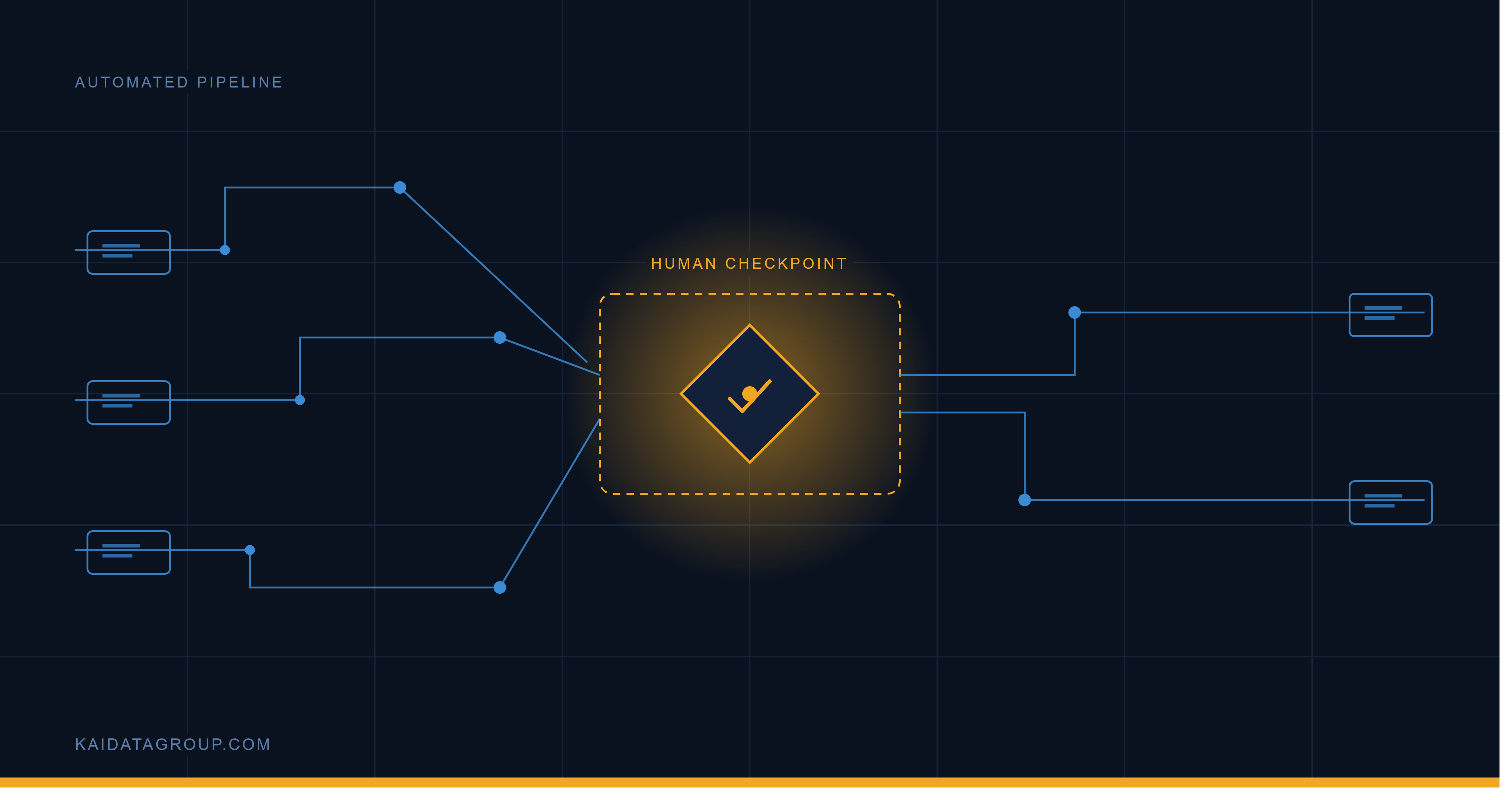
The second priority is implementing mid-task rule verification for any agent operating in regulated workflows or making consequential business decisions. This does not require rebuilding the entire agent architecture immediately. It requires adding explicit checkpoints where the agent's current behavior is validated against its defined governance parameters at regular intervals, with human review triggered when drift is detected.
The third priority is evaluating external policy enforcement for agents handling compliance-sensitive tasks. The Microsoft Agent Governance Toolkit approach, intercepting agent actions and validating them against an external policy engine before execution, is the correct architectural direction for agents that cannot be trusted to maintain their own compliance rules through extended sessions. For organizations under EU AI Act obligations, this architecture is not optional. It is the mechanism that makes human oversight of long-running AI agents technically feasible.
The fourth priority is updating AI governance documentation to address long-running agent behavior explicitly. Governance frameworks that specify what rules agents are deployed with, without specifying how compliance with those rules is maintained and monitored throughout extended operation, are incomplete for the agentic AI environment most organizations are now operating in.
The KAIDATA Connection
Context drift is a symptom of a governance infrastructure deficit that KAIDATA helps organizations identify and close.
The agent governance frameworks that most organizations deployed in 2024 and 2025 were designed for the AI they were deploying at the time: short-session tools that responded to user queries within a single context window. The agentic AI that is operating in enterprise environments in 2026 runs over hours and days, accumulates context across thousands of intermediate steps, and makes consequential decisions that are only visible in aggregate after the fact.
Building the governance architecture that is appropriate for long-running agentic AI, the external policy enforcement, the mid-task verification checkpoints, the context management design, and the audit trail infrastructure that makes agent behavior reviewable after the fact, is exactly the foundational work that determines whether AI agents in production are reliable and defensible or simply fast and ungoverned.
The failure mode is documented. The architectural solutions are available. The organizations that build the right governance infrastructure before an audit exposes the gap will be in a fundamentally different position than the ones that discover it afterward.
The agent is running right now. The question is whether you can tell what it is doing.