The Number That Keeps Going Up
VentureBeat Intelligence published its August 2026 Pulse survey results this week covering 184 enterprise respondents with 100 or more employees. The headline finding: 64% of enterprises have traced a confidently wrong AI agent answer to problems in their own company data in the past six months. Of those, nearly half experienced it more than once.
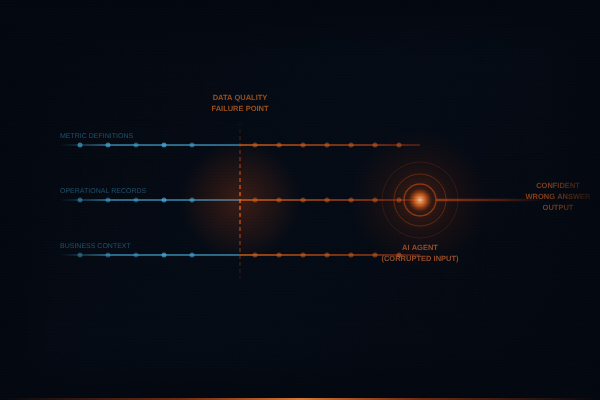
The word confidently is doing important work in that sentence. These are not cases where the AI flagged uncertainty or declined to answer. These are cases where the agent gave a wrong answer with the same assurance it gives right ones, and the source of the error was data the organization owns and controls.
That figure has been rising every quarter VentureBeat has measured it. Their June 2026 survey found 57% of enterprises had traced agent errors to bad context. Their July 2026 survey found 68%. Their August survey found the problem recurring at nearly half of affected organizations. The trajectory is in one direction. More deployment, more data-caused failures, less ability to distinguish them in real time from correct outputs.
This is the research finding that the broader enterprise AI conversation has not fully absorbed. The discussion about AI errors tends to focus on model hallucinations: cases where the model generates content that is plausible-sounding but factually wrong. Model hallucinations are real and worth managing. They are not, according to every major enterprise AI survey conducted in 2026, the primary source of AI agent errors in production. The primary source is data. Specifically, data that is missing, stale, inconsistently defined, or simply absent from the context the agent operates in.
What a Confidently Wrong Answer Actually Costs
The distinction between a model that says it does not know and a model that confidently provides a wrong answer is not semantic. It is the difference between a failure mode that is visible and one that is invisible until something downstream goes wrong.
When an AI agent flags uncertainty or declines to answer, a human can step in. The workflow may slow, but the error does not propagate. When an AI agent produces a confident wrong answer based on bad data, that answer enters the workflow, influences downstream decisions, and may travel through multiple automated steps before a human encounters an outcome that does not match expectations. By that point, reconstructing exactly where and why the error occurred requires audit trails and context documentation that most organizations have not built.
The specific types of data failures VentureBeat's research identified are consistent across its three most recent surveys: wrong metric definitions, stale data that no longer reflects current conditions, and missing documents that the agent needed to answer correctly. These are not exotic failure modes. They are the routine consequences of data that was never properly governed for the use case the agent is now being asked to perform.
Wrong metric definitions emerge when different parts of an organization define the same concept differently. Revenue recognized by finance versus revenue tracked by sales. Customer count defined by active contracts versus customer count defined by users who logged in last month. When an agent queries a system built around one definition and applies the result to a question implicitly framed around another, the answer is wrong and the model has no mechanism to detect the discrepancy.
Stale data is the consequence of deploying agents against data stores that are not updated at the cadence the agent's use case requires. An agent making recommendations based on inventory data that is twelve hours old in a high-velocity environment will produce confident recommendations that do not reflect current conditions. The model does not know the data is stale because staleness is a property of the data's relationship to time, not a property of the data itself.
Missing documents produce the most dangerous failure mode of the three. When an agent queries for context that does not exist in the data store, it does not necessarily fail gracefully. In many cases it reasons from whatever context is available and produces an answer that omits the information that was missing. The answer sounds complete. The gap is invisible without knowing what should have been there.
Why the Number Has Risen Every Quarter
The rising failure rate across VentureBeat's quarterly surveys is not primarily a sign that organizations are getting worse at managing data. It is a sign that they are deploying more agents into more complex workflows against data that was not prepared for agentic use.
The pattern VentureBeat's research surfaced is counter-intuitive but consistent: enterprises building or running a governed semantic layer report recurring context failures at 50%, against 21% for those without one. Organizations with better context infrastructure are catching twice as many failures as organizations without it. The ones without a governed context layer are not failing less. They are failing more, and detecting less.
This dynamic explains why the failure rate keeps rising even as organizations invest more in AI infrastructure. Investment in models, agents, and deployment tooling does not reduce data-caused failures. Only investment in data governance, context management, and the infrastructure that ensures agents operate on accurate, complete, and well-defined information reduces data-caused failures. Most organizations are investing heavily in the former and insufficiently in the latter.
VentureBeat's cross-survey research covering 573 enterprise leaders found that 57% to 64% of enterprises plan to switch or add vendors within 12 months across every major AI infrastructure category. The organizations that are not generating the AI outcomes they expected are reaching for new tools rather than examining the data foundation the tools run on. That is an expensive way to discover that the data is the problem.
The Confidence Problem Is Also a Trust Problem
The broader consequence of confidently wrong AI agent answers is not just the individual errors they produce. It is what those errors do to organizational trust in AI-assisted decisions over time.
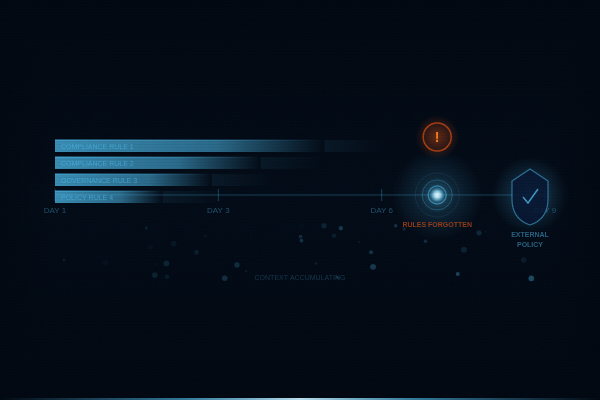
VentureBeat's agentic reliability research, published the same week as the data error findings, found that 56% of enterprises allow AI agents to make automated production changes, down from 75% in July. That 19-point decline in three months is the fastest documented reversal in autonomous AI deployment authority on record. The organizations pulling back are not doing so because the models got worse. They are doing so because confident wrong answers eroded the trust required to delegate consequential decisions to autonomous agents.
The recovery path from that trust deficit is not better models. It is demonstrable data quality. Organizations that can show a board or a regulator that their AI agents operate on data that is accurate, complete, current, and consistently defined are the ones that can sustain and expand autonomous agent deployment. The ones that cannot demonstrate it are the ones experiencing the trust collapse the VentureBeat data documents.
This is the enterprise AI governance dynamic that most organizations have not yet connected to their data strategy. Governance conversations tend to focus on model behavior: what the agent is allowed to do, who can approve its actions, how its outputs are reviewed. Those are real governance requirements. They sit on top of a more fundamental requirement that the data the agent reasons over is trustworthy enough to produce outputs worth governing.
What Fixes This and What Does Not
The intuitive response to AI agent errors caused by bad data is to build a retrieval layer that brings better context into the agent's decision-making. Retrieval-augmented generation, semantic layers, context APIs. These are the infrastructure categories VentureBeat's surveys show enterprises actively investing in.
Retrieval infrastructure helps. It does not substitute for data quality. An agent that retrieves from a well-organized but inaccurate data store will retrieve inaccurate context more efficiently. The retrieval layer determines what context is available to the agent. The quality of that context determines whether the agent's confident answers are right or wrong.
The organizations generating the most consistent AI agent performance in 2026 are the ones that addressed data quality, consistency, and governance before building retrieval infrastructure on top of it. The sequence matters. Retrieval architecture built on ungoverned data produces better-organized wrong answers. Retrieval architecture built on governed data produces answers the organization can stand behind.
The specific practices that distinguish organizations experiencing the lowest rates of data-caused AI failures are consistent across 2026 research. They maintain active data governance programs with defined ownership for each data domain the agents access. They enforce explicit staleness thresholds that trigger updates before data age creates failure risk. They maintain canonical definitions for key business metrics that are enforced across systems rather than defined per-system. And they have built audit trails that connect agent outputs to the specific data sources that informed them, which is what makes it possible to identify and fix data quality problems when confident wrong answers do surface.
These are not technology investments. They are organizational design investments. The technology to implement them is available to any enterprise. What distinguishes the organizations that have made them is the decision to treat data governance as an operational priority rather than a compliance activity.
The KAIDATA Connection
The VentureBeat research confirms at population scale what KAIDATA sees in individual client engagements: organizations deploy AI before their data is ready, discover the gap when agents produce confident wrong answers in production, and then face the harder and more expensive work of retrofitting data governance onto a deployed AI system.
The foundational work KAIDATA does with clients, assessing data quality across the domains AI agents will access, establishing governance frameworks that maintain accuracy and consistency at the cadence agentic workflows require, and building the audit trail infrastructure that makes data-caused failures visible and fixable, is precisely the work that determines whether an organization falls into the 64% or stays out of it.
The 64% figure has risen every quarter this year. The organizations that are not in it are not lucky. They built the data foundation before the agents arrived. The ones that built the agents first are discovering the cost of that sequencing decision one confident wrong answer at a time.
That cost is recoverable. But the recovery is the same foundational work that should have come first. The question is whether to do it before a confidently wrong answer causes a consequential failure, or after.