The Number Behind the Delay
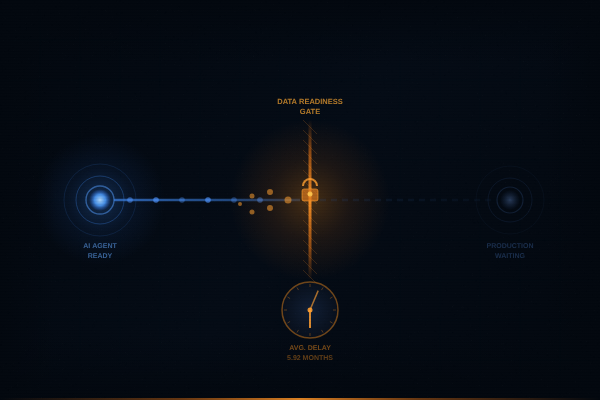
AvePoint's State of AI 2026 report, which surveyed 750 enterprise IT leaders across financial services, healthcare, and government, contains a finding that reflects how most organizations are experiencing the gap between AI ambition and AI operation: 86% of enterprises delayed AI agent deployments in the past year, and the average delay was 5.92 months.
The reason those deployments were delayed is not budget, not talent, and not technology. The primary blocker, consistent across the survey, was unresolved data security and governance concerns. Organizations built the agents. Then they discovered the data infrastructure those agents would run on was not ready to support them safely.
Generative AI deployments faced nearly the same dynamic: 86.9% were delayed, also by an average of just under six months, for the same underlying reasons.
This is not a story about organizations moving slowly. It is a story about the cost of sequencing AI deployment before data readiness. Six months of delay is what that sequencing decision costs on average, before accounting for the organizational friction, the sunk development costs, and the competitive window that closes while a deployment sits in remediation.
What the Delay Is Actually Waiting For
The data and governance gaps that triggered these delays are not obscure technical problems. They are the routine consequences of building AI deployment roadmaps without first auditing the data those deployments will depend on.
AvePoint's research found that 78.1% of enterprises say at least half their data is over five years old, up from 70.7% in 2025. AI agents operating against stale data produce outputs that reflect conditions that no longer exist. An organization cannot resolve that by reviewing the agent's logic or testing its prompts. Staleness is a property of the data, not the model, and addressing it requires data governance work that most AI deployment timelines do not include.
The visibility gap compounds the problem. By 2026, 17.6% of organizations report they do not know whether employees are using unsanctioned generative AI tools, nearly triple the 6.3% figure from 2025. For AI agents specifically, 21.1% of organizations cannot tell whether unsanctioned agents are being built and run inside their own workflows. When an organization cannot see what its agents are doing, it cannot govern them. When it cannot govern them, it cannot safely deploy them at scale. That is the ceiling the six-month delay is hitting.
The breach numbers make the stakes concrete. Organizations reporting at least one AI agent security breach rose to 88.4% in 2026. The most common incidents were data leakage and manipulation through malicious inputs. Confidence did not prevent these breaches: 72% of organizations that described themselves as "very confident" in preventing unauthorized data access experienced an AI-related access incident anyway. The gap between confidence and outcome is what ungoverned data produces.
Why Organizations Keep Arriving at the Same Delay
The pattern behind the six-month delay is structural. Most enterprise AI deployment roadmaps are built around model selection, agent architecture, and use case prioritization. Data readiness assessment is either treated as a parallel workstream or assumed to be covered by existing data management practices.
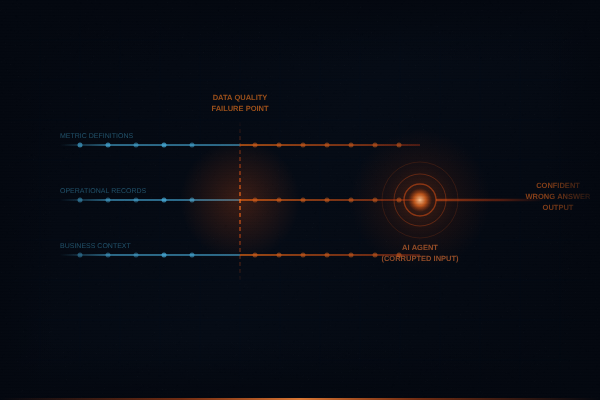
It is not. Data management practices built for traditional analytics and reporting workflows are not designed to support agentic use cases, which require data to be accurate at the cadence the agent operates, consistently defined across the systems the agent queries, and auditable to the level that makes the agent's outputs defensible. Organizations discovering these gaps after the agent is built are not discovering something unexpected. They are discovering the cost of an assumption they made at the start of the project.
AvePoint's CEO put the dynamic plainly in the report's findings: speed of deployment becomes speed of exposure. The organizations rushing to close the six-month delay without addressing its underlying cause are not solving the problem. They are shortening the window between deployment and the next security incident.
What the Delay Actually Costs Beyond the Calendar
Six months of delayed deployment is the most visible cost in AvePoint's findings. It is not the largest one.
The organizations that delayed because of data and governance concerns are the ones that caught the problem before deployment. The ones that did not delay are the ones contributing to the 88.4% breach rate. A six-month delay to resolve a data readiness gap is an investment. A security incident after deployment is a cost with no corresponding investment.
AI-generated data is already 35.5% of enterprise data and is expected to reach 42.1% within twelve months. That means the data governance problem is not static. AI is generating new data on top of existing data that was already inadequately governed. Without active governance infrastructure, the foundation those agents operate on degrades as deployment scales. The delay organizations experienced in 2026 will be harder to close in 2027 if the governance work that caused the first delay is not completed during the window that delay creates.
The organizations investing in this window are visible in the data. Securing data used for AI training is the top-rated future investment among AvePoint's surveyed leaders, at 79.5%. Sixty-two percent plan to increase spending on tools that monitor agent actions for policy alignment. The enterprises that treated their delay as a signal about data readiness rather than a scheduling problem are the ones closing the gap.
The Sequence That Prevents the Delay
The organizations that deploy AI agents without experiencing the six-month remediation delay are not avoiding hard problems. They are solving them in a different order.
Data readiness assessment before architecture decisions means the agent is built to operate on data that is already understood: its staleness thresholds are known, its governance ownership is defined, its definitions are consistent across the systems the agent will query, and its audit trail infrastructure exists before the agent needs it. Those are not complex requirements. They are requirements that take significant time to fulfill, and that time is shorter and less expensive when it comes before agent development than when it comes after.
The six months that most enterprises spent waiting in 2026 is available to any organization that chooses to spend it before the build rather than between the build and deployment. The output is the same amount of work. The sequence is what determines whether that work shows up as a delay or as a foundation.
The KAIDATA Connection
The deployment delay AvePoint's research documents at population scale is the specific gap KAIDATA addresses with clients before their agent architecture decisions are made. The data readiness assessment work, the governance framework that defines ownership, staleness thresholds, and canonical definitions across the domains agents will access, and the audit trail infrastructure that makes agent outputs defensible, these are the components that determine whether an organization is in the 86% waiting six months or the 14% that deployed without the remediation cycle.
The work is the same either way. What KAIDATA clients do is complete it in the sequence that turns it from a delay into a foundation. The organizations that have not done it yet are not behind. They are at the same decision point every organization faces: whether to build the foundation before the agents or after them.
Building it after costs an average of six months. The AvePoint research now has the number. The question is whether that number changes the sequencing decision.