From Pilot to Fleet in Fifteen Months
Salesforce published the second edition of its Agentic Enterprise Index in August 2026, drawing on aggregated platform data from thousands of businesses using Agentforce between February 2025 and April 2026, alongside a survey of 4,689 respondents across the US, UK, France, Canada, Australia, Spain, and Italy. The report is the most comprehensive combined deployment-and-survey study of enterprise agentic AI published to date, and its headline finding reframes the conversation that many organizations are still having.
The average enterprise now runs 13 AI agents in production, up from five in February 2025. That is a 160% increase over fifteen months, compounding at 7% per month. Agent creation time fell 53%, from four days to 1.9 days. The average agent now handles six distinct business skills, up from two at the start of the tracking period. Salesforce's Agentforce platform logged 734 million Agentic Work Units in April 2026 alone, growing at 15% month over month.
Seven in ten customer service sessions at leading organizations are now handled autonomously by agents. Retail organizations using agents saw 4x higher online sales growth. The pilot stage has definitively ended for a meaningful cohort of enterprise organizations.
The part of this story that is not getting equal coverage is what comes after the fleet is deployed. CTO confidence in their organization's ability to scale AI fell to 48% in June 2026, the same month that agent deployment data reached its highest point yet. More deployment, less confidence. The gap between those two trajectories is where the real story is.
Half the Agents Are Running Alone
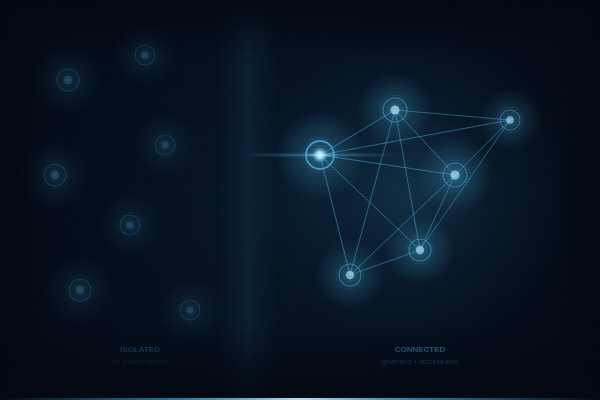
Salesforce's 2026 Connectivity Benchmark Report, published alongside the Agentic Enterprise Index, found that 50% of deployed agents operate completely independently, without connecting to other agents or shared systems. Belitsoft's 2026 AI Agent Trends research confirmed the same dynamic: enterprises run an average of 12 to 13 agents, but half of them work in silos.
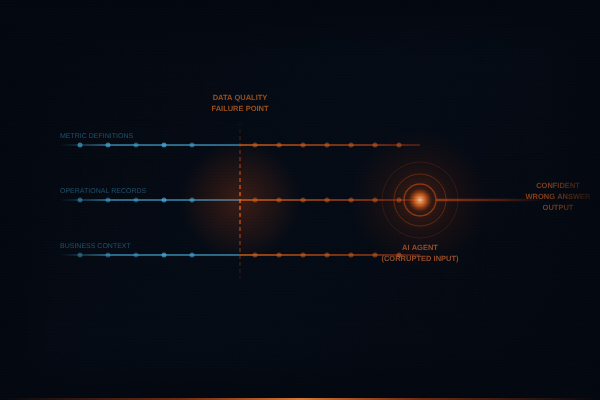
That finding is more consequential than it appears. An agent that operates in isolation from other agents and systems is not a member of an agentic workforce. It is an expensive point solution. It cannot share context with adjacent workflows. It cannot escalate to a human using a defined protocol. It cannot be audited as part of a system because it is not part of one.
The Salesforce data shows agents activating at 7% compound monthly growth. The same data shows that the infrastructure connecting those agents to each other and to enterprise systems is not growing at anything like the same rate. Organizations are deploying agents faster than they are building the orchestration layer, the data access architecture, the governance frameworks, and the human oversight mechanisms that make a fleet of agents into an agentic enterprise rather than a collection of isolated experiments.
This is the organizational version of the problem we documented with Uber's AI budget overrun. Uber deployed AI tools at scale before building the governance and cost management infrastructure to support that scale. Enterprise organizations deploying agent fleets before building governance and orchestration infrastructure are making the same sequencing mistake at a different layer. The cost shows up differently: in incidents, in errors, in compliance exposures, and in the quiet accumulation of agent behavior that no single person has visibility over, but the underlying cause is identical.
What Nobody Is Tracking
The most important question missing from most enterprise AI agent discussions is also the simplest: does anyone in your organization have a complete inventory of every agent currently running in production?
Not a list of agents that have been formally approved. A list of every agent that is actually executing tasks, accessing data, making decisions, or interacting with customers and employees right now. In most organizations, that list does not exist. Individual teams have deployed agents for their specific use cases. Each agent has its own data access model, its own escalation logic, its own implicit governance assumptions. Collectively, they constitute a system that no single leader can see.
The cost visibility problem is the most immediate expression of this. After Uber burned through its 2026 AI budget in four months, Anthropic built spend controls directly into Claude Enterprise. Microsoft issued an internal memo telling engineering staff that token consumption would be subject to the same discipline applied to any other critical resource. The reason these interventions were necessary is that organizations deploying agents without centralized visibility had no mechanism to see what the fleet was costing until the bill arrived.
The governance exposure is the deeper problem. Obsidian Security raised $85 million in August 2026 at a $1.1 billion valuation, with nearly 70% of its clients reporting that AI agents now interact with business data. The security category for AI agent identity, permissions, and access management exists because agents operating without centralized governance create attack surfaces that traditional security tools were not designed to address. An agent with access to enterprise systems is an identity. An untracked agent is an unmanaged identity, and at 13 agents per organization and growing, the scale of that exposure is not trivial.
The Two Deployment Models and What They Tell You
Salesforce's Sophistication Index, a five-point scale scoring the cognitive complexity of agent actions, reveals a bifurcation in how organizations are actually deploying agents that has direct implications for governance strategy.
Consumer-facing industries such as retail, financial services, and travel are deploying high-volume, task-specific agents. These agents handle immediate customer needs at speed and scale, averaging one to two actions per agent. The volume is extraordinary: Pandora, the jewelry brand, used agents to handle dramatic surges in customer inquiries during peak seasons, maintaining response quality while absorbing volume that would have overwhelmed human teams.
Operationally complex and regulated industries including manufacturing, public sector, and healthcare are deploying versatile, multi-step agents capable of cross-functional business logic. These agents handle fewer interactions but with significantly greater complexity, reaching levels 4 and 5 on Salesforce's Sophistication Index. They make decisions that require understanding of multiple systems, multiple data sources, and multiple business rules simultaneously.
The governance requirements for these two deployment models are different in important ways. High-volume, task-specific agents require governance frameworks built for scale: monitoring systems that can track hundreds of millions of agent interactions, anomaly detection that flags pattern deviations across enormous volumes of routine decisions, and escalation protocols that route the small percentage of interactions requiring human judgment efficiently. Multi-step, cross-functional agents require governance frameworks built for complexity: audit trails that can reconstruct the full decision chain across multiple systems, human oversight mechanisms positioned at the points of highest decision risk, and documentation frameworks that satisfy both internal accountability requirements and external compliance obligations.
Most organizations that have not explicitly designed governance for their specific deployment model have neither. They have general statements about AI governance that were written before the agent fleet existed and have not been updated to reflect what the fleet actually does.
The Bottleneck Has Shifted and Most Organizations Have Not
The most important operational insight in the Salesforce data is also the most actionable. If it takes 1.9 days to deploy a new agent, deployment time is not the bottleneck. The bottleneck is deciding where agents should work, what data they should access, and what human oversight looks like.
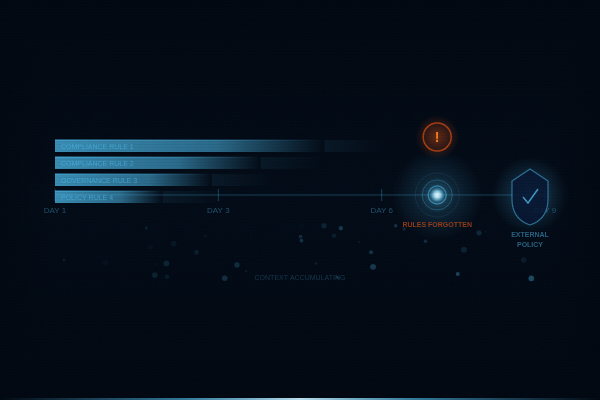
That shift has not yet been reflected in how most organizations structure their AI programs. The investment in AI tools, platforms, and deployment infrastructure has been substantial. The investment in the governance, orchestration, and oversight infrastructure that determines whether deployed agents produce reliable, defensible, measurable outcomes has not kept pace.
The CrewAI 2026 State of Agentic AI Survey of 500 C-level executives at organizations with more than $100 million in revenue found that 34% cite security and governance as the top evaluation factor for agentic platforms. That figure will rise. The organizations experiencing agent-related incidents, cost overruns, and compliance exposures in 2026 will not repeat the governance deficit in 2027. Their experiences are the early warning signal for every organization that has not yet encountered those consequences at scale.
The Gartner framework describes specialized agents as musicians in an orchestra. The metaphor is more useful than it might appear. An orchestra without a conductor, a shared score, or a rehearsal process does not produce music. It produces noise. Thirteen agents without shared orchestration, shared data access governance, and shared oversight frameworks do not constitute an agentic enterprise. They constitute thirteen sources of potential value that cannot be reliably harnessed.
What the Organizations Getting This Right Are Doing
The organizations generating measurable, defensible returns from their agent fleets share a specific set of practices that distinguish them from the majority still accumulating governance debt.
They maintain a live agent inventory. Every agent in production is documented: what it does, what data it accesses, what systems it can modify, who is accountable for its outputs, and what the escalation protocol is when it encounters a decision it cannot reliably make. This inventory is not a one-time audit. It is a living document updated when agents are deployed, modified, or retired.
They have defined governance tiers based on agent sophistication. A level 1 agent that looks up customer records requires different oversight than a level 4 agent that makes cross-functional decisions affecting multiple systems. Organizations that apply the same governance framework to both are either over-governing simple agents, which slows deployment, or under-governing complex ones, which creates exposure. Tiered governance calibrates the oversight to the actual decision risk.
They have connected cost visibility to agent activity before scale makes it invisible. The organizations that avoided Uber's situation did not avoid it by spending less. They avoided it by instrumenting their agent deployments so that cost was visible at the team level, the use case level, and the agent level before quarterly budget conversations made the numbers feel abstract. Visibility at the right level of granularity is what enables the spending discipline that prevents the budget floor from disappearing.
They treat the human oversight design as an architectural decision, not an afterthought. The percentage of agent decisions requiring human review, the conditions that trigger escalation, and the human review workflow itself are all designed before deployment rather than discovered in production when something goes wrong. The organizations with the lowest incident rates are the ones that spent the most time designing the edge cases before the agents encountered them.
The KAIDATA Lens
The Salesforce Agentic Enterprise Index confirms that the agent deployment wave is real, accelerating, and producing measurable commercial returns for the organizations that have built the right infrastructure underneath it. The simultaneous decline in CTO confidence confirms that most organizations are deploying faster than they are building that infrastructure.
The gap between 13 agents per organization and the governance frameworks required to run 13 agents reliably is the specific problem KAIDATA is built to close. Building the agent inventory discipline, the governance tier framework, the cost visibility architecture, and the human oversight design that converts an agent fleet into a genuinely agentic enterprise is exactly the foundational work that determines whether the deployment numbers in Salesforce's index translate into the business outcomes those numbers promise.
The bottleneck is not deployment. It never was. The bottleneck has always been the organizational infrastructure that makes deployment reliable, defensible, and measurable. The organizations that resolve that bottleneck before their agent fleet scales further will be the ones on the right side of the next version of this data.