The Budget Line That No One Modeled Correctly
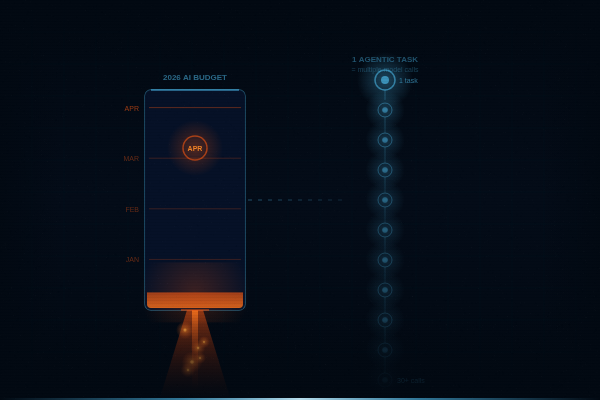
In December 2025, Uber rolled out Anthropic's Claude Code to roughly 5,000 engineers and encouraged them to use it as much as possible. The company even built an internal leaderboard ranking teams by total AI usage volume, turning adoption into a competitive sport. By April 2026, four months into the fiscal year, Uber's entire annual AI tools budget was gone. Uber's CTO described it as a head-exploding moment.
Uber then did what any organization in that position would do: it implemented a $1,500 monthly cap per employee per agentic coding tool, trackable through an internal dashboard, with exceptions permitted case by case. A retroactive governance system installed after the damage was done.
A separate company reportedly spent $500 million in a single month after deploying AI access without usage caps. Microsoft, as we covered earlier this year, began canceling internal Claude Code licenses across a major division before its June 30 fiscal close for the same reason. These are not edge cases. They are the leading edge of a pattern that is working its way through enterprise organizations at every scale.
An agentic task is not one API call. It is a sequence of them. The agent plans, loads context, calls tools, verifies outputs, and retries, generating 5 to 30 model calls per user-initiated task according to Gartner's March 2026 analysis, and up to 1,000 times more tokens than a single-turn query according to GitHub's own May 2026 research. The budgets that organizations set in 2025 for their 2026 AI tools spend were built on single-turn query assumptions. The agentic AI that got deployed in 2026 operates on fundamentally different economics. Nobody had modeled it correctly because no enterprise had deployed agentic AI at scale before.
That is the honest explanation for what happened at Uber. It is also the explanation that matters least going forward, because the data is now public and the pattern is documented. Organizations that set AI budgets in 2026 for 2027 without accounting for agentic consumption dynamics are making the same modeling error Uber made. The difference is they are making it with the Uber example already on record.
Why Agentic AI Economics Are Structurally Different
The core issue is not that Claude Code is expensive or that Uber's engineers used it irresponsibly. The core issue is that the pricing model for agentic AI is fundamentally incompatible with the budgeting assumptions that most organizations carry over from traditional software procurement.
Microsoft 365 Copilot Enterprise sells at $30 per user per month with an annual commitment. The price caps the vendor's upside and gives finance teams a flat line item they can multiply by headcount. Anthropic's consumption model gives the vendor unlimited upside on heavy users and gives finance teams almost no forward visibility. Both models are defensible for different workloads. The problem is that most organizations treated them as interchangeable in their planning cycles, which is exactly what produced Uber's outcome.
The math behind agentic consumption is not intuitive until you have seen it in production. A developer asking Claude Code to refactor a module, write tests, debug the output, and document the changes is not submitting four requests. They are initiating a multi-step agentic workflow that may involve dozens of model calls, each consuming tokens at a rate that a per-seat pricing mental model does not prepare you for. When 5,000 engineers are running those workflows simultaneously, and when an internal leaderboard is actively incentivizing maximum usage, the consumption curve accelerates in ways that quarterly budget cycles cannot absorb.
GitHub is moving Copilot to a credit-based system, and analysts expect most vendors to introduce separate consumption pools for agents and tool use over the next 12 to 24 months. The vocabulary will vary: credits, requests, messages, compute units, but the direction is set. Flat-rate inference for unbounded agentic workloads was never going to survive the math. Anthropic's introduction of spend controls and model access management in Claude Enterprise in July 2026 is the vendor's acknowledgment that the market needs governance infrastructure it did not previously provide.
For enterprise organizations planning their AI budgets for 2027, the lesson from Uber is not to avoid agentic AI. It is to model it accurately before deploying it at scale.
The Measurement Problem Underneath the Cost Problem
Uber's COO Andrew Macdonald articulated something important in a May 2026 interview that has received less attention than the budget headline. "That link is not there yet," he said, referring to the connection between the company's rising use of Claude Code and innovations meant to serve consumers. "Maybe implicitly there's more that is getting shipped, but it's very hard to draw a line between one of those stats and 'Okay now we're actually producing like 25% more useful consumer features.'"
That statement is the real story underneath the budget overrun. Uber did not just spend its AI budget. It spent its AI budget without being able to demonstrate what the spending produced. The budget collapsed because the consumption model was miscalibrated. But the inability to measure whether the spending generated value is a deeper and more structural problem that the $1,500 monthly cap does not solve.
This is the pattern we have documented throughout 2026 across multiple research programs: organizations are investing in AI at scale and discovering that the measurement infrastructure to show what it produced was never built. Only 15% of AI decision-makers can point to an EBITDA lift they can attribute to AI. Fewer than one-third can tie AI value to P&L changes. The Uber situation is the cost side of that same measurement gap. If you cannot show what the spending returned, you cannot defend the budget, and you cannot set the right budget for the following year.
Organizations that respond to Uber's situation by implementing spending caps are solving the wrong problem first. Spending caps prevent runaway costs. They do not create the attribution model that shows which AI investment generated value and which generated token consumption without measurable business output. A $1,500 monthly cap per engineer produces a known cost. It does not produce a known return.
What Governance Actually Looks Like Before the Crisis
The organizations managing AI costs well in 2026 share a set of practices that differ structurally from the approach Uber took.
The first is modeling agentic consumption before deployment rather than after. This means understanding the specific workflows the AI will be used for, estimating the token consumption per workflow based on the number of model calls an agentic task requires, projecting usage across the target user population, and building the budget from that model rather than from a per-seat or flat-rate assumption. It is more work than multiplying headcount by a subscription price. It produces a budget that survives contact with production.
The second is decoupling adoption incentives from consumption metrics. The internal leaderboard that Uber built was designed to drive adoption. It also drove token consumption with no corresponding measurement of business value generated. Incentive structures that reward usage without connecting it to outcomes are not AI strategy. They are adoption theater with an uncapped budget attached. The organizations that will generate sustainable AI returns structure their incentives around outcomes, not activity.
The third is implementing governance infrastructure before deployment reaches scale. Anthropic created budget alert features into Claude Enterprise including model access control and warning messages when teams will exceed their budget. The fact that Anthropic needed to build these features is itself a signal: vendors never create such features for customers who have historically spent money wisely. The feature exists because a significant number of enterprise customers needed it after discovering the problem in production. Having that governance in place before deployment scales is significantly less disruptive than installing it after a budget has already been exhausted.
The fourth is building the attribution model that connects AI spending to business outcomes. This is the work that Uber's COO implicitly acknowledged was absent when he noted that the link between Claude Code spending and consumer feature delivery was not there yet. Without attribution, organizations cannot distinguish AI spending that generates value from AI spending that generates activity. Both produce token consumption. Only one produces return.
The Industry-Wide Signal in Anthropic's Response
Anthropic's decision to build spend controls into Claude Enterprise in July 2026 is not just a product feature. It is a market signal that deserves attention from every enterprise AI procurement team.
Vendors build governance features when enough of their customers have needed them urgently enough to demand them. The spend controls, model access management, and budget alert features that Anthropic shipped reflect the reality that enterprise customers had discovered the hard way that deploying agentic AI without cost governance is not sustainable. The feature arrived because the market required it.
The broader implication is that the economics of agentic AI are not stable at current pricing models. Procurement teams that want predictability will need to negotiate committed-spend agreements at fixed rates rather than ride consumption pricing, and organizations that built their AI cost models on flat-rate or subscription assumptions will see their effective unit costs rise as vendors rationalize the economics of agentic workloads.
For enterprise organizations that have not yet deployed AI agents at scale, the Uber situation and the Anthropic response together define what responsible deployment sequencing looks like: model the consumption economics of the specific agentic workflows you are deploying, implement spending governance before adoption reaches the scale where runaway consumption becomes possible, build the attribution infrastructure that connects spending to outcomes, and negotiate pricing structures that provide cost predictability rather than unlimited vendor upside.
The KAIDATA Lens
The Uber situation is simultaneously a cost management story, a measurement story, and a governance story. The cost overrun is the visible symptom. The measurement and governance gaps are the underlying conditions that made it possible.
KAIDATA helps organizations build the AI governance infrastructure, cost modeling frameworks, and outcome measurement systems that determine whether AI investment is manageable and defensible before deployment rather than discovered to be uncontrolled after. The work that would have prevented Uber's situation is not complicated in concept. It requires modeling agentic consumption correctly, structuring incentives around outcomes rather than usage, implementing spending controls before adoption scales, and building the attribution model that makes AI ROI visible.
That work is available to any organization willing to do it before the budget meeting where the equivalent of Uber's head-exploding moment arrives. The Uber disclosure is now public. The pattern is documented. The organizations that act on it before experiencing it will be in a materially different position than the ones that wait for their own version of April.